
Alivia


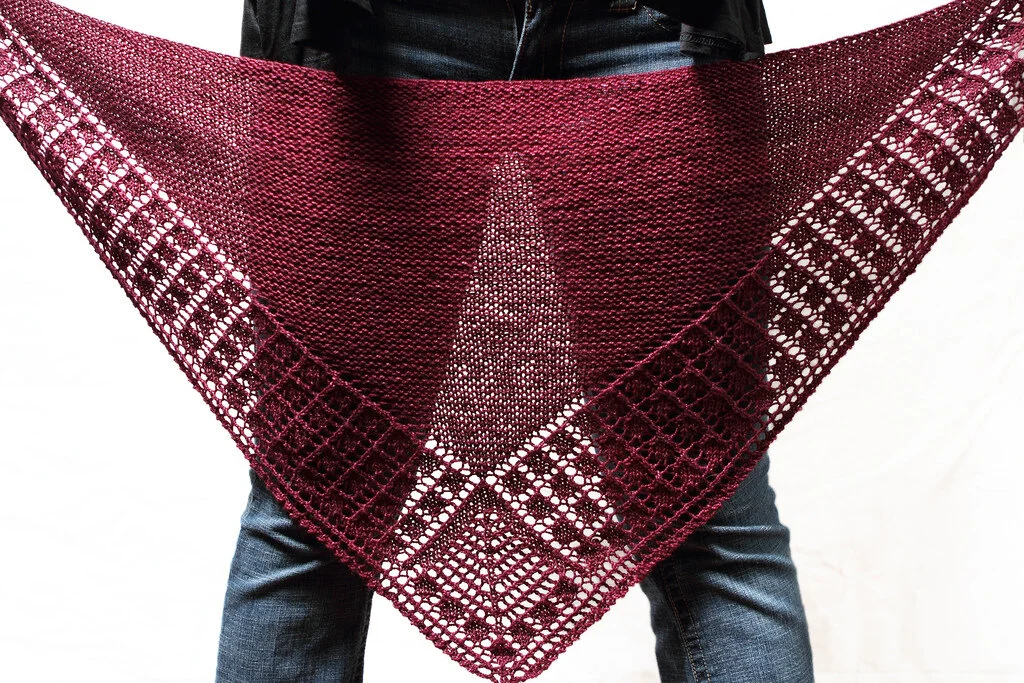
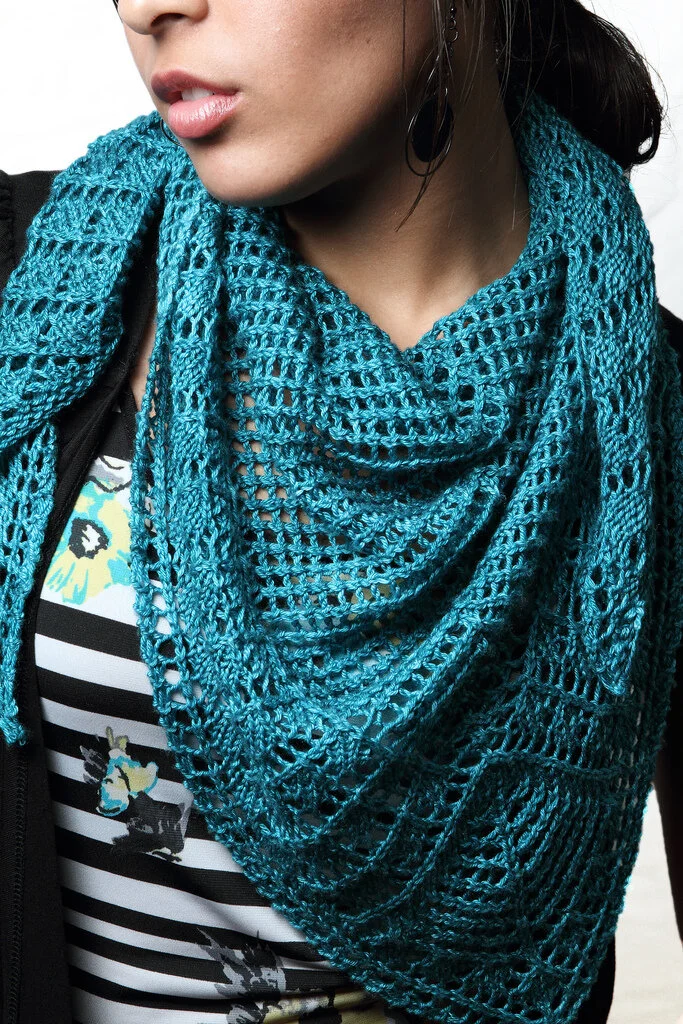
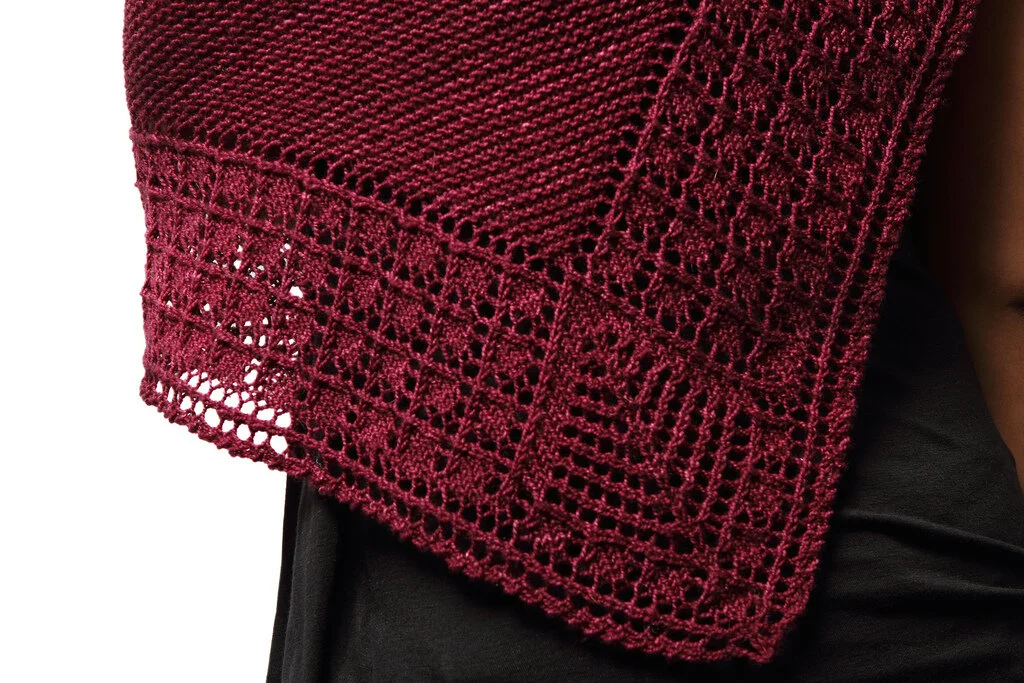

Alivia
When I started publishing patterns in mid-2010, I was eager to find my own voice and to explore my personal creativity and style. To develop ideas that felt distinctly mine. By early 2011, I’d published a few patterns, and a design question emerged: What if I worked a triangular shawl from the bottom point upward, instead of using a traditional garter tab cast on?
I cast on Alivia with that specific idea in mind. I wanted the lace to develop naturally as the shawl’s size increased, without the typical center spine. The bottom-up construction gave me exactly what I was looking for and kept the center clean and whole.
The first version came together in three days—faster than I anticipated—in a beautiful aqua-colored silk/merino fingering weight yarn. When I blocked it, the lace opened up with gorgeous drape, light and fluid. It was exactly what I’d imagined. At the same time, my brother-in-law and his wife were experimenting with dyeing yarn. They’d given me a tight twist merino in a gorgeous berry tone that I knew would be perfect for this shawl too.
But rather than making the same shawl again, I saw the opportunity to explore something else. Since the beginning of my design journey, I’d loved giving knitters options, and I wondered, what if I swapped the lace center for garter stitch? I made a second sample and, just like the first, it was quick and satisfying to knit, but each one had its own personality. The garter center version was understated and meditative, while the lace center version was layered in texture and visual interest.
The best part? One version didn’t mean sacrificing the other. I could offer something for the lace lover and something for the knitter seeking an easier entry point to lace. Two distinct looks, both inviting you to make it your own.
What makes this shawl special
Striking edging, two center options. A prominent diamond lace motif anchors the bottom, with a complementary geometric lace motif along the sides. Pick your center—lace or garter stitch—and knit what matches your style.
A lace pattern for all knitters. If you’ve been thinking about tackling lace but want something with a clear structure to follow, Alivia meets you there. The bottom-up construction keeps the lace repeating in a logical way. For seasoned lace knitters, it’s a simpler but modern design.
Works across yarn weights. Designed in fingering weight but takes beautifully to lace weight, sport weight, and even DK. The motifs scale naturally, and the drape stays gorgeous across the range.
Customizable depth and width. Keep repeating the main chart for your chosen center until you’re almost out of yarn. This is genuinely a one-skein project where your yarn dictates the final dimensions.
What other knitters have said
“Vanessa designs beautiful, practical pieces. While I am not fond of triangle shawls I find this design graceful and light (I did the centre lace/netting version) and it doesn’t have the ubiquitous centre spine (with the typical, uncreative yarn-overs) - therefore it looks beautiful, with nothing to interrupt the simple lace/netting design in the centre.”
“Made for my dear mother and modeled by my lovely daughter. . . . After two years, Mom says this is her favorite. She loves the way it lays on her shoulders, and she can wear it hidden under a coat or jacket if needed and then remove coat but still have the shawl on for warmth. I am glad to make her happy.”
“Very easy pattern, well written, and flexible, with two variations. Worked up very quickly and turned out just as I’d hoped.”
“This came out really well. The beginning design was a little challenging for me, but it soon became clear. The break with garter was terrific. I couldn’t use stitch markers but only 27 stitches of lace on either side was manageable. And it was really cool to work bottom up for a change! Great results. I am a big fan of Vanessa’s patterns.”
“Love love love this pattern! Will definitely make another shawl using this easy to follow pattern. Although Alivia is a charted design that required row counting (a 12 row repeat), it was so simple to follow. This shawl is knit from the bottom tip to the top edge, and therefore the number of stitches grow (in the garter stitch section) as you progress. As I had plenty of yarn I decided to continue knitting until I ran out of yarn.”

What you get
A beautiful, instant-download PDF with everything you need to knit Alivia:
Fully written instructions alongside detailed charts.
Pattern notes throughout to guide you through the construction.
Directions for both versions in the same pattern.
Pattern support comes with your purchase. If you have questions or hit a snag while you’re knitting, I’m always happy to help.
Ready to explore both versions?
When I started publishing patterns in mid-2010, I was eager to find my own voice and to explore my personal creativity and style. To develop ideas that felt distinctly mine. By early 2011, I’d published a few patterns, and a design question emerged: What if I worked a triangular shawl from the bottom point upward, instead of using a traditional garter tab cast on?
I cast on Alivia with that specific idea in mind. I wanted the lace to develop naturally as the shawl’s size increased, without the typical center spine. The bottom-up construction gave me exactly what I was looking for and kept the center clean and whole.
The first version came together in three days—faster than I anticipated—in a beautiful aqua-colored silk/merino fingering weight yarn. When I blocked it, the lace opened up with gorgeous drape, light and fluid. It was exactly what I’d imagined. At the same time, my brother-in-law and his wife were experimenting with dyeing yarn. They’d given me a tight twist merino in a gorgeous berry tone that I knew would be perfect for this shawl too.
But rather than making the same shawl again, I saw the opportunity to explore something else. Since the beginning of my design journey, I’d loved giving knitters options, and I wondered, what if I swapped the lace center for garter stitch? I made a second sample and, just like the first, it was quick and satisfying to knit, but each one had its own personality. The garter center version was understated and meditative, while the lace center version was layered in texture and visual interest.
The best part? One version didn’t mean sacrificing the other. I could offer something for the lace lover and something for the knitter seeking an easier entry point to lace. Two distinct looks, both inviting you to make it your own.
The Knitty-Gritty
Description
Alivia is a unique, triangular shawl worked from the bottom point to the upper edge. The beautiful lace border remains the focal point of the shawl and with two center stitch options, it can be worn either formally or casually. Modifying the size of the shawl to use less or more yarn, or a different weight of yarn, is as easy as repeating the second chart fewer or more times.
Finished Measurements
Lace Center Version: 54” (137 cm) wide; 23” (58 cm) deep
Garter Stitch Center Version: 50” (127 cm) wide; 19” (48 cm) deep
Yarn
380 yards (347 meters) or more fingering weight yarn
Magenta shawl (garter stitch center) pictured used a plied, merino, fingering weight yarn.
Aqua shawl (lace center) pictured used a plied, silk/merino, fingering weight yarn.
Needles
US 6 (4 mm) circular needle, 32” (80 cm), or size to obtain gauge or desired fabric
Gauge
22.5 sts and 33 rows = 4” (10 cm) in stockinette stitch, unblocked
Getting exact gauge is not critical, but it will affect the amount of yarn needed for your shawl.
Notions
(2) Stitch markers
(1) Split-ring or locking stitch marker (optional)
(1) Needle 3–4 sizes larger
Tapestry needle
Cast on and choose your center.
When I started publishing patterns in mid-2010, I was eager to find my own voice and to explore my personal creativity and style. To develop ideas that felt distinctly mine. By early 2011, I’d published a few patterns, and a design question emerged: What if I worked a triangular shawl from the bottom point upward, instead of using a traditional garter tab cast on?
I cast on Alivia with that specific idea in mind. I wanted the lace to develop naturally as the shawl’s size increased, without the typical center spine. The bottom-up construction gave me exactly what I was looking for and kept the center clean and whole.
The first version came together in three days—faster than I anticipated—in a beautiful aqua-colored silk/merino fingering weight yarn. When I blocked it, the lace opened up with gorgeous drape, light and fluid. It was exactly what I’d imagined. At the same time, my brother-in-law and his wife were experimenting with dyeing yarn. They’d given me a tight twist merino in a gorgeous berry tone that I knew would be perfect for this shawl too.
But rather than making the same shawl again, I saw the opportunity to explore something else. Since the beginning of my design journey, I’d loved giving knitters options, and I wondered, what if I swapped the lace center for garter stitch? I made a second sample and, just like the first, it was quick and satisfying to knit, but each one had its own personality. The garter center version was understated and meditative, while the lace center version was layered in texture and visual interest.
The best part? One version didn’t mean sacrificing the other. I could offer something for the lace lover and something for the knitter seeking an easier entry point to lace. Two distinct looks, both inviting you to make it your own.
Buy it on Ravelry.
You may also like . . .

Kaliope is a simple lace shawl pattern worked from the top center and outward to the edging using traditional shawl increases of four stitches per right side row. The diagonal lines of the shawl draw the eye toward the simple yet beautiful border where the columns of lace taper into points and transform into hexagonal shapes, ending with an elegant scalloped edge. The size of your shawl can be easily scaled up or down simply by changing the number of repeats of the main body chart. Directions are included for two edge size options.
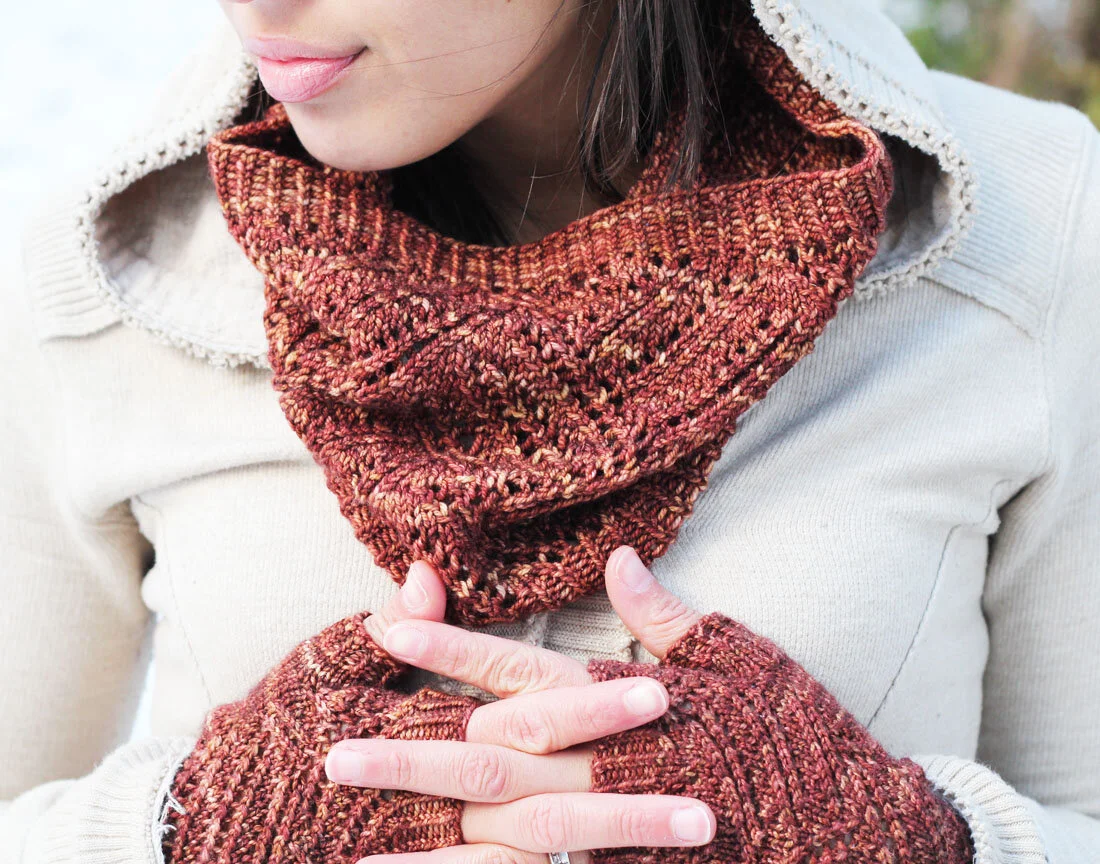
In October 2010, a talented indie yarn dyer whose work I loved announced a design contest. Two months, one new design, in any of her yarns. At that point, I’d been designing for just a few months, still finding my voice as a designer, so the timing felt perfect. There would also be not just one but two winners, so the chances felt good!
I cast on right away, using the dyer’s soft and luxurious MCN, a merino, cashmere, nylon blend. I wanted to create a set—a cowl and mitts that worked together but not as two separate projects. I made the first set in a teal colorway with earthy speckles, followed by a second set in a warm cinnamon. As I finished, I realized they’d each used exactly or just shy of one skein. That wasn’t by design; it just worked out that way.
The win came as such a validation. I was still so new to designing, and to have my work recognized alongside another designer’s? It gave me confidence to keep going and to trust that I had something to offer. I called it Dyade, a German word for a pair as well as a nod to my heritage and to how these two pieces were meant to function as one.
It’s a set that doesn't demand a big commitment—just one generous skein of fingering weight yarn in whatever color that speaks to you and a few evenings of knitting. You get to play with color and yarn and finish with something beautiful on your hands.

Sacha is the triangular interpretation of Charlize. Worked as a classic triangle from the top center and outward to the ruffled edging, the lace portion is intuitive yet simple, with each shawl half being complete mirror images of one another. Its large wingspan drapes beautifully around the neck or shoulders of its wearer & adds a touch of elegance to any outfit.