Dyade



Dyade
In October 2010, a talented indie yarn dyer whose work I loved announced a design contest. Two months, one new design, in any of her yarns. At that point, I’d been designing for just a few months, still finding my voice as a designer, so the timing felt perfect. There would also be not just one but two winners, so the chances felt good!
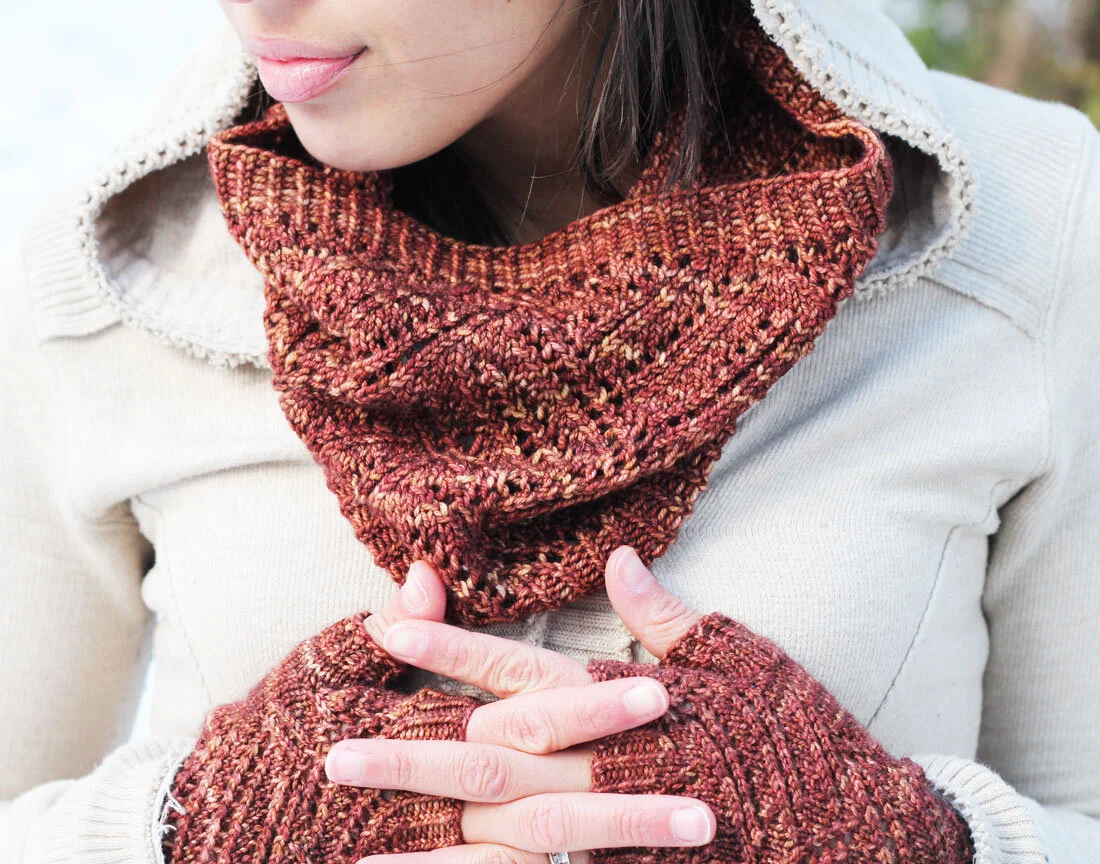
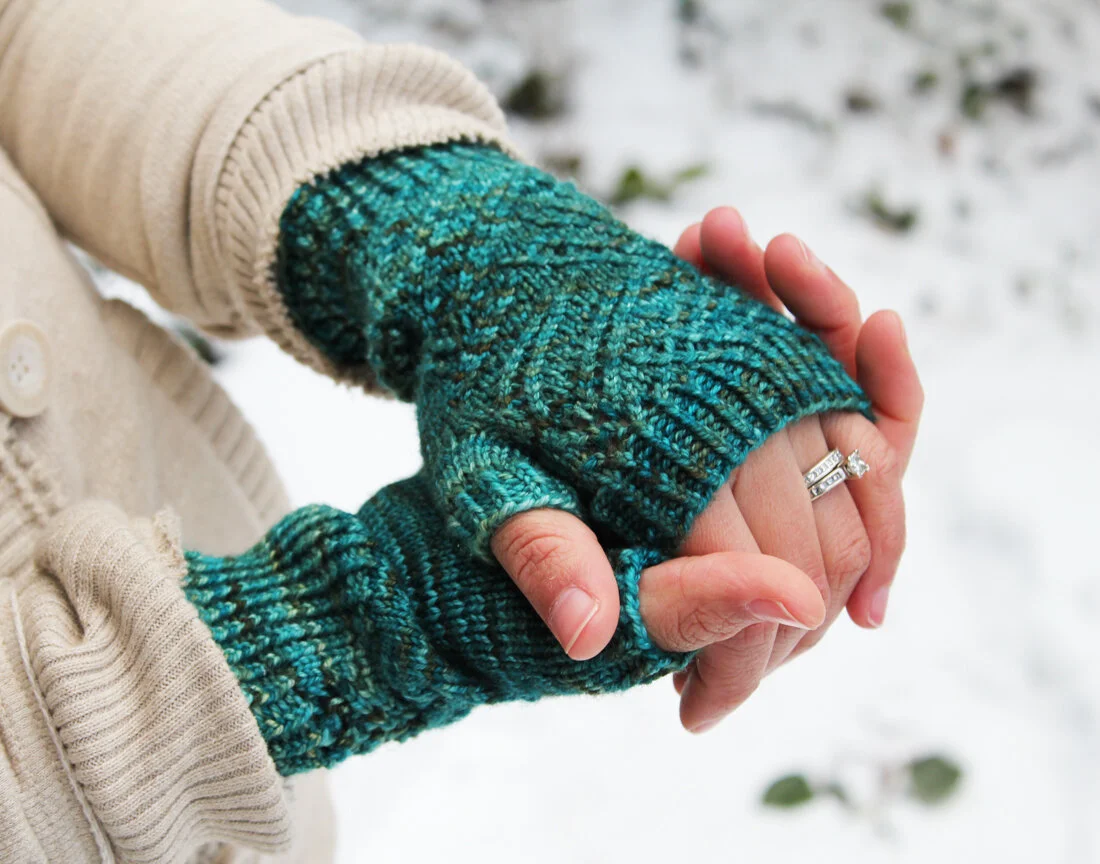
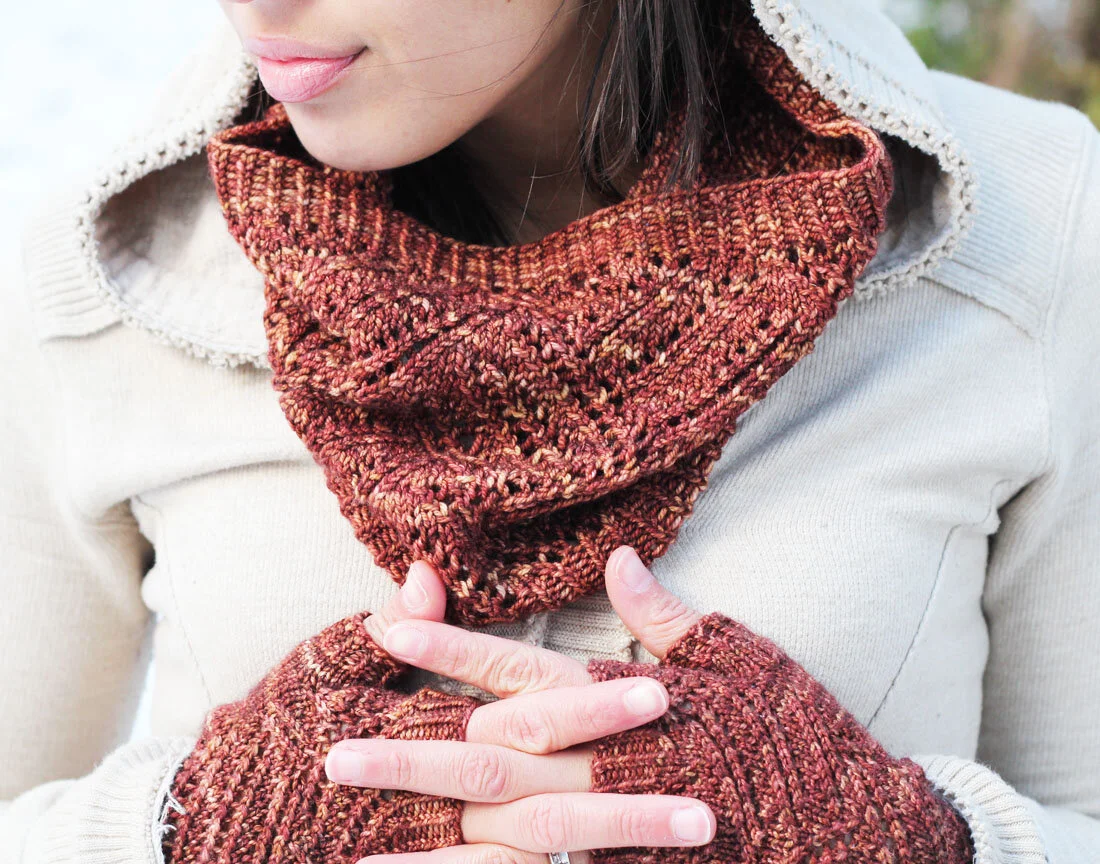
I cast on right away, using the dyer’s soft and luxurious MCN, a merino, cashmere, nylon blend. I wanted to create a set—a cowl and mitts that worked together but not as two separate projects. I made the first set in a teal colorway with earthy speckles, followed by a second set in a warm cinnamon. As I finished, I realized they’d each used exactly or just shy of one skein. That wasn’t by design; it just worked out that way.
The win came as such a validation. I was still so new to designing, and to have my work recognized alongside another designer’s? It gave me confidence to keep going and to trust that I had something to offer. I called it Dyade, a German word for a pair as well as a nod to my heritage and to how these two pieces were meant to function as one.
It’s a set that doesn't demand a big commitment—just one generous skein of fingering weight yarn in whatever color that speaks to you and a few evenings of knitting. You get to play with color and yarn and finish with something beautiful on your hands.
What makes this set special
A lace pattern that keeps you engaged. The stitch pattern has movement that makes you pay attention without demanding focus. Not round and round mindless—just the right amount of “stay present” to make the knitting satisfying.
One-skein wonder. Up to 430 yards of sock/fingering weight yarn gets you both the cowl and mitts. That happy accident from 2010 is built into the design, and you get to use a special skein or stash bust!
Twisted rib meets lace. The cowl pairs a unique lace stitch with twisted ribbing for texture that looks intricate but knits more intuitively than you’d expect. The fingerless mitts echo the same stitch family, so they feel cohesive without being repetitive.
Quick to knit, customizable to suit your style. Adjust the mitts to fit your hands. Resize the cowl wider or narrower. One test knitter even looped the cowl into an infinity scarf; the design adapts to what you want to make.
What other knitters have said
“Love this cowl. This the first slouchy cowl I’ve made, and I could easily become addicted to this style. I will be making the fingerless mitts later this year.”
“The cowl was a blast to knit… not just round and round, you actually have to pay attention to be sure you get the ‘shift’ in the right spot.”
“Lovely lace pattern. Quick and good instructions both charted and written. ”
“This cowl is stunning! It is one of my “most proud projects” of the year. . . . I cannot wait for the weather to cool down so I can show this off.”

What’s included
In the downloadable PDF you’ll find . . .
Written and charted instructions for both the cowl and mitts, so you can follow however you prefer
Detailed notes for resizing the mitts and tips for adjusting the cowl’s dimensions
I’ve also published video tutorials for the following key techniques:
This is your winning set.
In October 2010, a talented indie yarn dyer whose work I loved announced a design contest. Two months, one new design, in any of her yarns. At that point, I’d been designing for just a few months, still finding my voice as a designer, so the timing felt perfect. There would also be not just one but two winners, so the chances felt good!
I cast on right away, using the dyer’s soft and luxurious MCN, a merino, cashmere, nylon blend. I wanted to create a set—a cowl and mitts that worked together but not as two separate projects. I made the first set in a teal colorway with earthy speckles, followed by a second set in a warm cinnamon. As I finished, I realized they’d each used exactly or just shy of one skein. That wasn’t by design; it just worked out that way.
The win came as such a validation. I was still so new to designing, and to have my work recognized alongside another designer’s? It gave me confidence to keep going and to trust that I had something to offer. I called it Dyade, a German word for a pair as well as a nod to my heritage and to how these two pieces were meant to function as one.
It’s a set that doesn't demand a big commitment—just one generous skein of fingering weight yarn in whatever color that speaks to you and a few evenings of knitting. You get to play with color and yarn and finish with something beautiful on your hands.
The Knitty-Gritty
Description
Accessorize in style this winter with a cozy, oversized cowl and matching fingerless mitts that feature a unique lace stitch pattern coupled with twisted ribbing. This set is quick to knit and even easier to size, making it perfect for last minute gift knitting—or yourself, of course!
Sizes
Cowl: Small (Medium)
Mitts: One Size
Finished Measurements
Cowl: 12 (13½)” / 30.5 (34) cm wide and 9½ (10)” / 24 (25.5) cm tall [24 (27)” / 61 (68.5) cm circumference] when laid flat, lightly blocked
Cowl size can be easily modified as noted in pattern.
Mitts: 3¼ (8 cm) wide, 7” (18 cm) tall [6½ (16.5 cm) circumference] when laid flat, unstretched
Mitts shown on hands that measure 7½” (19 cm) around knuckles. 1” (2.5 cm) negative ease intended. Adjust needle size as needed to achieve gauge or to minimally size mitts up or down. Additional guidelines for modifying the mitts’ size are provided in pattern.
Yarn
355 (430) yards / 325 (393) meters fingering weight yarn [Cowl Only: 215 (290) yards / 197 (265) meters; Mitts Only: 140 yards / 128 meters]
Needles
Cowl: US 6 (4 mm) circular needle, 16 (24)” / 40 (60) cm long
Mitts: US 1 (2.25 mm) double pointed needles or circular needle, 40” (100 cm) or longer for magic looping
Change needle size if necessary to obtain correct gauge.
Gauge
Cowl: 22 sts and 18 rnds = 4” (10 cm) in twisted rib, slightly stretched OR blocked
Mitts: 28.5 and 48 rnds = 4” (10 cm) in stockinette stitch, unblocked
Make something beautiful from one skein.
In October 2010, a talented indie yarn dyer whose work I loved announced a design contest. Two months, one new design, in any of her yarns. At that point, I’d been designing for just a few months, still finding my voice as a designer, so the timing felt perfect. There would also be not just one but two winners, so the chances felt good!
I cast on right away, using the dyer’s soft and luxurious MCN, a merino, cashmere, nylon blend. I wanted to create a set—a cowl and mitts that worked together but not as two separate projects. I made the first set in a teal colorway with earthy speckles, followed by a second set in a warm cinnamon. As I finished, I realized they’d each used exactly or just shy of one skein. That wasn’t by design; it just worked out that way.
The win came as such a validation. I was still so new to designing, and to have my work recognized alongside another designer’s? It gave me confidence to keep going and to trust that I had something to offer. I called it Dyade, a German word for a pair as well as a nod to my heritage and to how these two pieces were meant to function as one.
It’s a set that doesn't demand a big commitment—just one generous skein of fingering weight yarn in whatever color that speaks to you and a few evenings of knitting. You get to play with color and yarn and finish with something beautiful on your hands.
Buy it on Ravelry.
You may also like . . .

After I released the Indira shawl, I wore it everywhere—to work, knit nights, a winter wedding. Anywhere I wanted elegance without overthinking it. But in some settings, like around my office, I realized a smaller accessory would be more practical. I found myself wanting something I could throw on and that would stay put. A cowl with the same stitch patterns felt perfect, so I started sketching.
The size and shape were crucial. I wanted the same beautiful drape as the shawl and decided to make the cowl wider at the base, narrower at the top. I also wanted to knit as much of that striking double-braided cable as possible. Sideways construction was the answer. It gave me the opportunity to play with short rows, which I’d been wanting to explore more, and to include not just one but two cables! The fun part was problem-solving and figuring out how to execute it so the pattern would be repeatable. When I finally drew a short-row diagram that looked promising, I circled it and wrote, “This works!”
I knit two prototypes to test the construction. The first was too narrow at the top and never saw the light of day. The second one was where things clicked. I was amazed to see the short rows work exactly as I’d sketched them, creating that perfect funnel shape. This sample needed some fine-tuning, but it quickly became part of my knitwear rotation too.
Once the design came together, finding the perfect yarn was next. A bold, dark red colorway in La Bien Aimée’s catalog stood out as the one. I savored every stitch from cast on to bind off, and I was especially excited to be able to wear my finished cowl when meeting Aimée for the first time at Stitches West 2020.
I’ve made two more Indira Cowls since then, including one in yellow for La Bien Aimée’s boutique in Paris, and I constantly reach for any one of the three I still have. It’s exactly the kind of accessory I was looking for—elegant, practical, wearable. Maybe it’s what you’ve been looking for too.

When I started publishing patterns in mid-2010, I was eager to find my own voice and to explore my personal creativity and style. To develop ideas that felt distinctly mine. By early 2011, I’d published a few patterns, and a design question emerged: What if I worked a triangular shawl from the bottom point upward, instead of using a traditional garter tab cast on?
I cast on Alivia with that specific idea in mind. I wanted the lace to develop naturally as the shawl’s size increased, without the typical center spine. The bottom-up construction gave me exactly what I was looking for and kept the center clean and whole.
The first version came together in three days—faster than I anticipated—in a beautiful aqua-colored silk/merino fingering weight yarn. When I blocked it, the lace opened up with gorgeous drape, light and fluid. It was exactly what I’d imagined. At the same time, my brother-in-law and his wife were experimenting with dyeing yarn. They’d given me a tight twist merino in a gorgeous berry tone that I knew would be perfect for this shawl too.
But rather than making the same shawl again, I saw the opportunity to explore something else. Since the beginning of my design journey, I’d loved giving knitters options, and I wondered, what if I swapped the lace center for garter stitch? I made a second sample and, just like the first, it was quick and satisfying to knit, but each one had its own personality. The garter center version was understated and meditative, while the lace center version was layered in texture and visual interest.
The best part? One version didn’t mean sacrificing the other. I could offer something for the lace lover and something for the knitter seeking an easier entry point to lace. Two distinct looks, both inviting you to make it your own.

Kaliope is a simple lace shawl pattern worked from the top center and outward to the edging using traditional shawl increases of four stitches per right side row. The diagonal lines of the shawl draw the eye toward the simple yet beautiful border where the columns of lace taper into points and transform into hexagonal shapes, ending with an elegant scalloped edge. The size of your shawl can be easily scaled up or down simply by changing the number of repeats of the main body chart. Directions are included for two edge size options.