Indira Cowl


Indira Cowl
After I released the Indira shawl, I wore it everywhere—to work, knit nights, a winter wedding. Anywhere I wanted elegance without overthinking it. But in some settings, like around my office, I realized a smaller accessory would be more practical. I found myself wanting something I could throw on and that would stay put. A cowl with the same stitch patterns felt perfect, so I started sketching.
The size and shape were crucial. I wanted the same beautiful drape as the shawl and decided to make the cowl wider at the base, narrower at the top. I also wanted to knit as much of that striking double-braided cable as possible. Sideways construction was the answer. It gave me the opportunity to play with short rows, which I’d been wanting to explore more, and to include not just one but two cables! The fun part was problem-solving and figuring out how to execute it so the pattern would be repeatable. When I finally drew a short-row diagram that looked promising, I circled it and wrote, “This works!”
I knit two prototypes to test the construction. The first was too narrow at the top and never saw the light of day. The second one was where things clicked. I was amazed to see the short rows work exactly as I’d sketched them, creating that perfect funnel shape. This sample needed some fine-tuning, but it quickly became part of my knitwear rotation too.
Once the design came together, finding the perfect yarn was next. A bold, dark red colorway in La Bien Aimée’s catalog stood out as the one. I savored every stitch from cast on to bind off, and I was especially excited to be able to wear my finished cowl when meeting Aimée for the first time at Stitches West 2020.
I’ve made two more Indira Cowls since then, including one in yellow for La Bien Aimée’s boutique in Paris, and I constantly reach for any one of the three I still have. It’s exactly the kind of accessory I was looking for—elegant, practical, wearable. Maybe it’s what you’ve been looking for too.
What makes the Indira Cowl special?
Sideways construction — the shaping keeps you engaged throughout, and the result drapes beautifully.
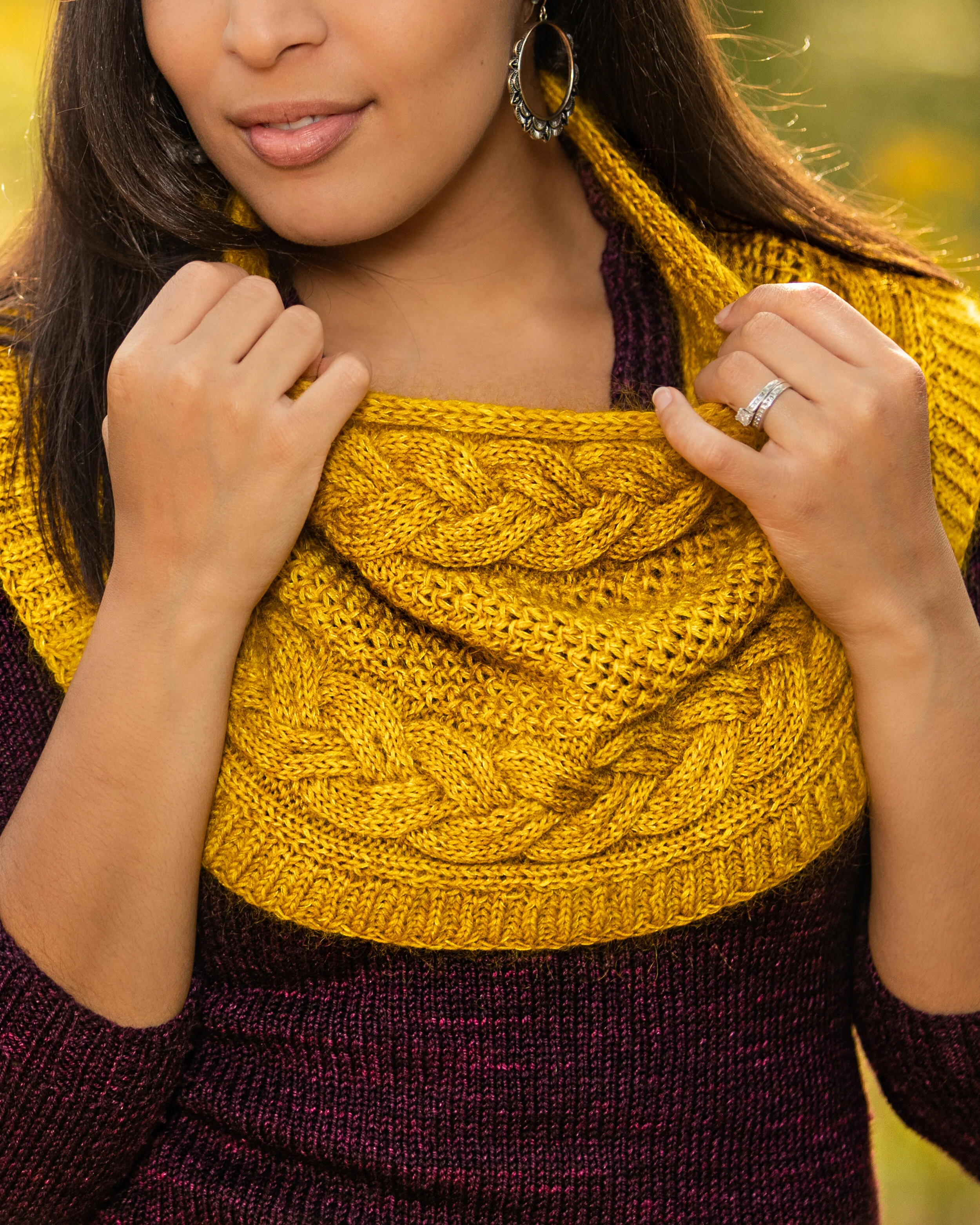
Two bold cables — The double-braided cables running through the fabric are striking without being heavy. They catch the eye and hold their shape.
Lace that breathes — Yarn overs and slipped stitches create openness and movement. The fabric drapes instead of sitting stiff around your neck.
Grafted invisibly in pattern — The seam is a detail, not a distraction. It’s meant to disappear into the design.
Fisherman’s rib finish — A close cousin to brioche, but simpler to work. Deep, squishy texture that people will want to touch.
💡 Make it a matching set: Pair this cowl with the Indira Mitts for a coordinated look, or layer it over a Nydia sweater.
What other knitters have said
“Wowza! Spectacularly pleased with this FO. I haven’t even blocked it yet, but this is something special.
My adult son who is oblivious to everything I knit saw the FO and exclaimed that it looked professionally made - and it does, because the design is exquisite.
This is no bland triangle cowl, a lot of thought and planing went into getting the garment to fall and drape to the body, in a way that is especially flattering. Coupled with beautiful design elements, new techniques at every turn, like the rib and cast off, it call came together to create a pattern that is technically seamless, and absolutely gorgeous!
I had to resist every urge to just do the simple easy ways I already know, I thought about doing a simpler K1blt, p rib or a simple stretchy bind off, but I am so glad that I trusted the pattern and knit every step as intended.
This designer is an absolute gem with a real eye for fashion and the known-how to make real world garments that actually look good on humans, not just in photos and patterns that are detailed and easy to implement! I can’t wait to explore the rest of her catalog of designs.
Absolute respect for this kind of dedication to the craft - this was a next level knit.”

What’s included?
In the downloadable PDF, you'll find . . .
Notes on modifying the size if you want to adjust the height or width for your proportions or layering preference
Step-by-step directions + a video tutorial for the invisible provisional cast on — the foundation that makes grafting seamless
Full written instructions plus a chart for the cable and lace section — follow whichever way works best for you
Short-row guidance — They’re the key to getting that funnel shape right, and I walk you through how to do them
Grafting instructions in bite-sized sequences so you can see exactly how the seam comes together
Professional finishing tips for the bind off edge — because the last few rows deserve as much care as the first
Yes, you can make this. I’ve got you.
After I released the Indira shawl, I wore it everywhere—to work, knit nights, a winter wedding. Anywhere I wanted elegance without overthinking it. But in some settings, like around my office, I realized a smaller accessory would be more practical. I found myself wanting something I could throw on and that would stay put. A cowl with the same stitch patterns felt perfect, so I started sketching.
The size and shape were crucial. I wanted the same beautiful drape as the shawl and decided to make the cowl wider at the base, narrower at the top. I also wanted to knit as much of that striking double-braided cable as possible. Sideways construction was the answer. It gave me the opportunity to play with short rows, which I’d been wanting to explore more, and to include not just one but two cables! The fun part was problem-solving and figuring out how to execute it so the pattern would be repeatable. When I finally drew a short-row diagram that looked promising, I circled it and wrote, “This works!”
I knit two prototypes to test the construction. The first was too narrow at the top and never saw the light of day. The second one was where things clicked. I was amazed to see the short rows work exactly as I’d sketched them, creating that perfect funnel shape. This sample needed some fine-tuning, but it quickly became part of my knitwear rotation too.
Once the design came together, finding the perfect yarn was next. A bold, dark red colorway in La Bien Aimée’s catalog stood out as the one. I savored every stitch from cast on to bind off, and I was especially excited to be able to wear my finished cowl when meeting Aimée for the first time at Stitches West 2020.
I’ve made two more Indira Cowls since then, including one in yellow for La Bien Aimée’s boutique in Paris, and I constantly reach for any one of the three I still have. It’s exactly the kind of accessory I was looking for—elegant, practical, wearable. Maybe it’s what you’ve been looking for too.
The Knitty-Gritty
Description
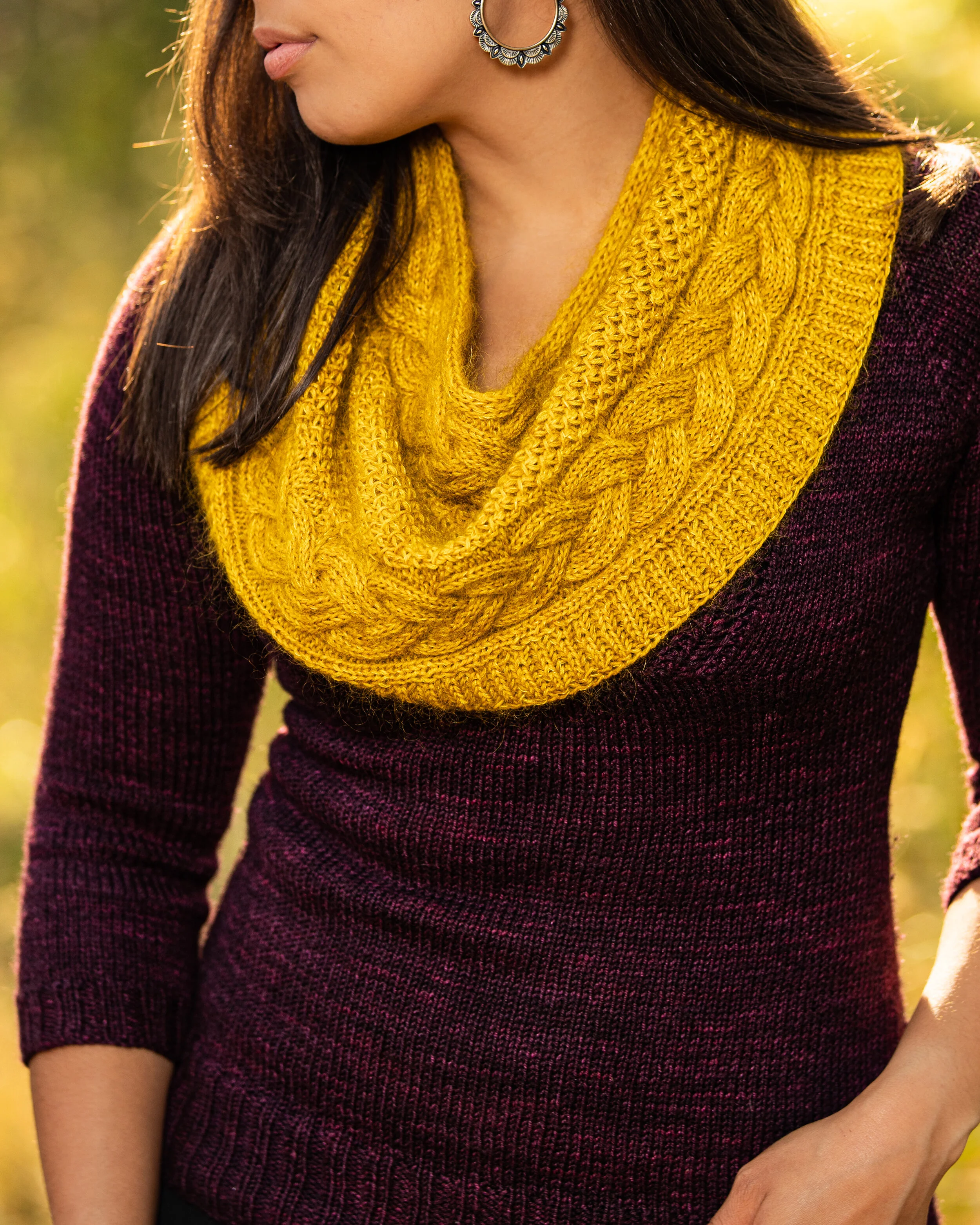
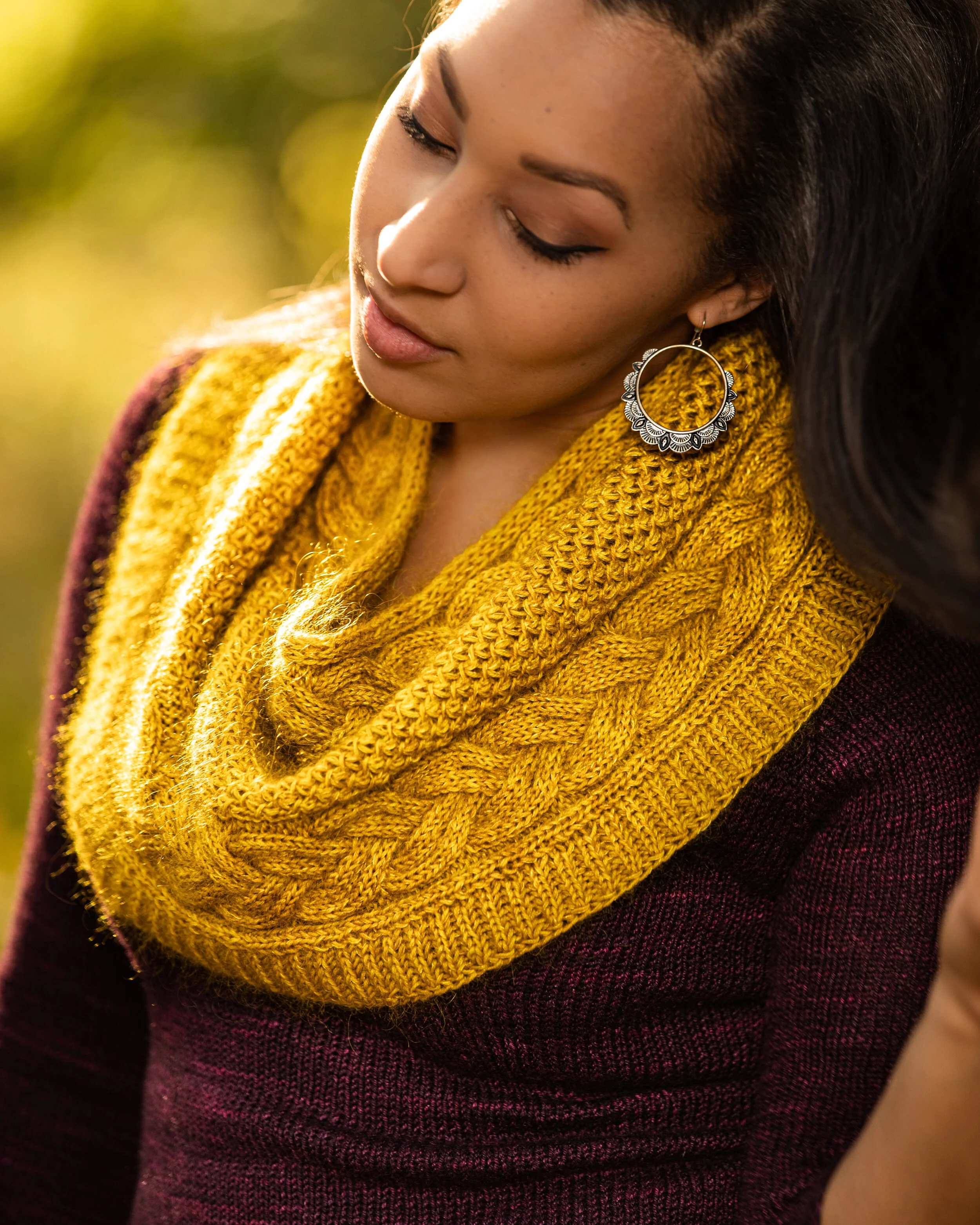
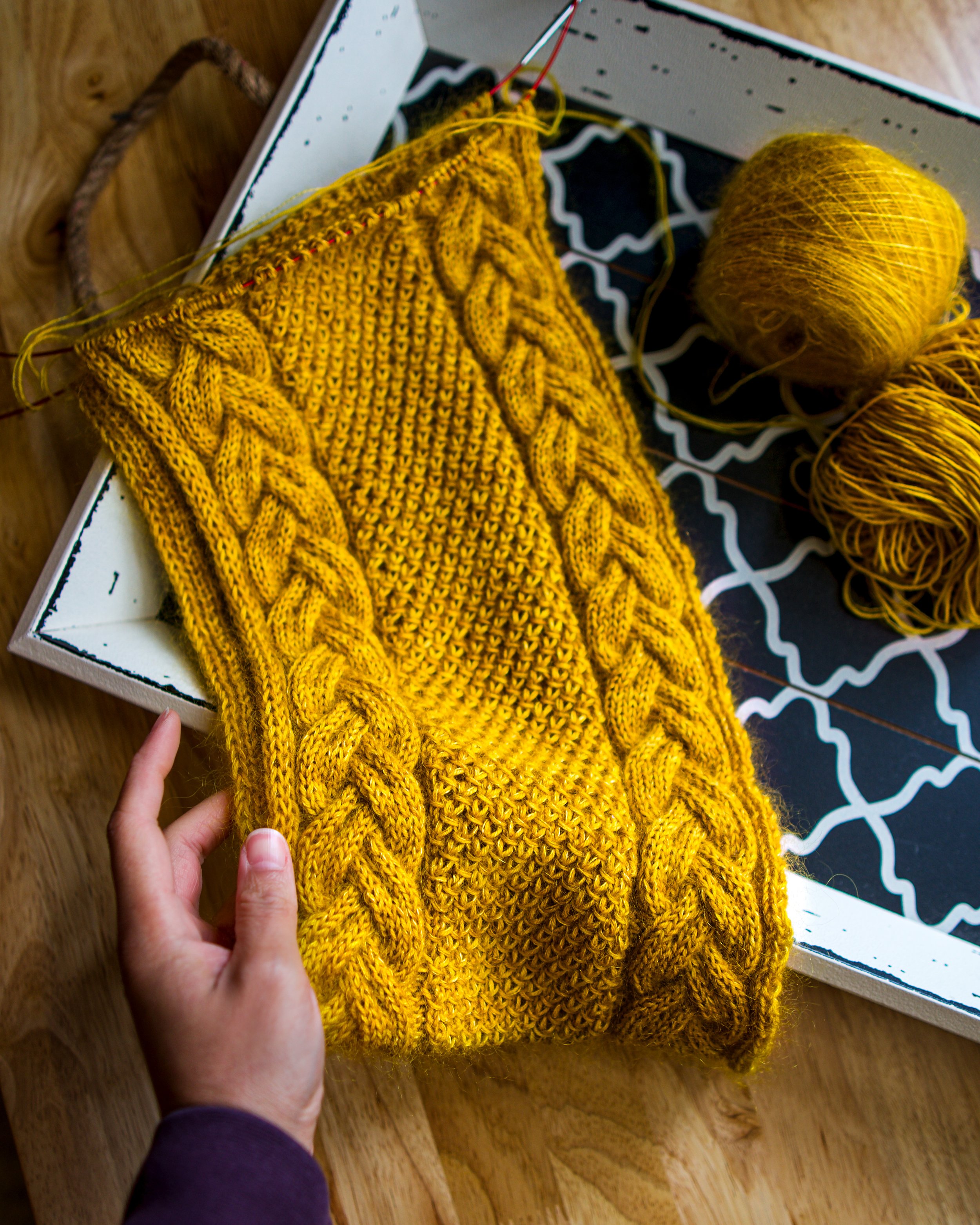
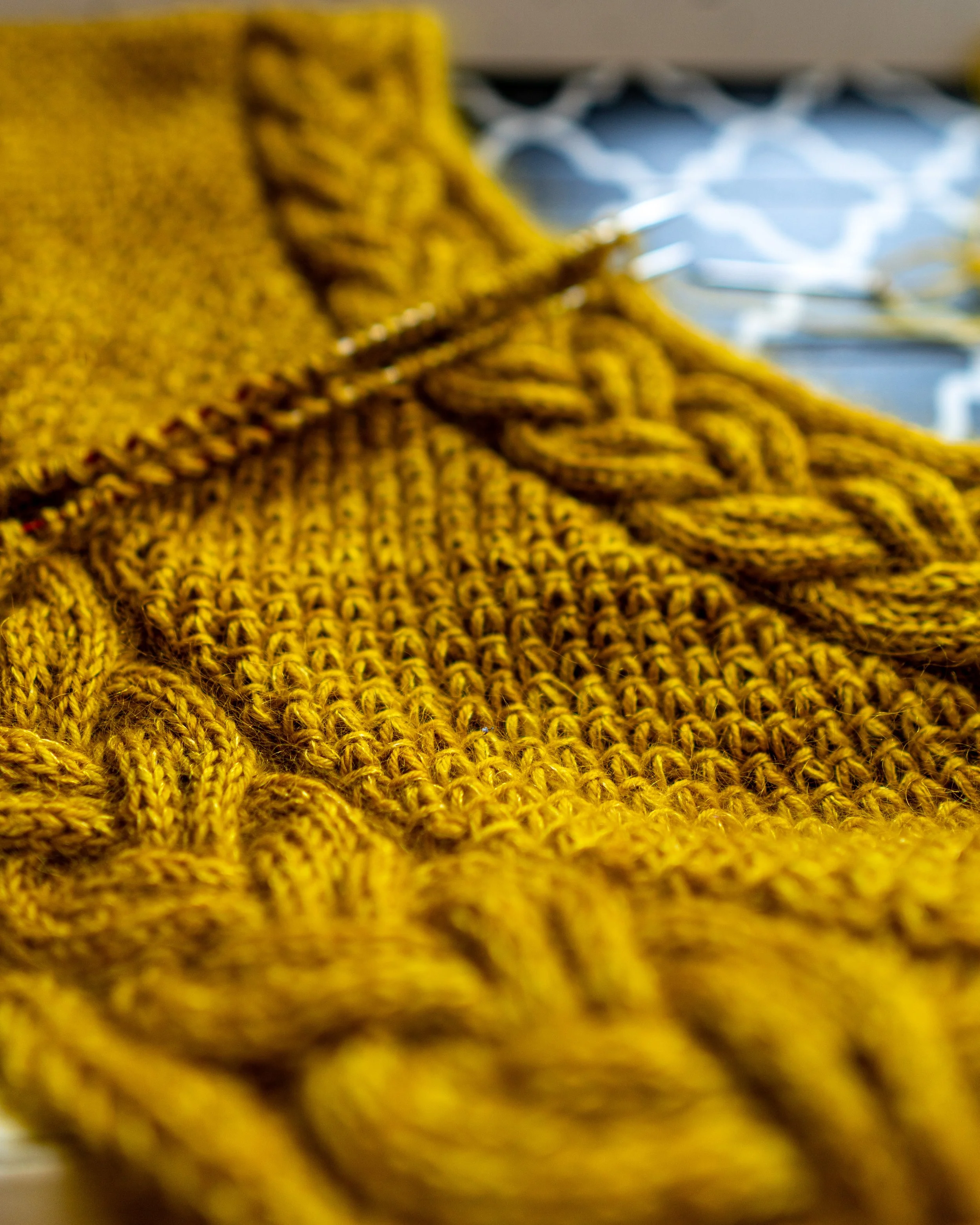
The Indira Cowl is an elegant, semifunnel-shaped cowl featuring two unique double-braided cables, simple lace, and luxurious fisherman’s rib. The cowl is worked from side to side, beginning with a provisional cast on and knit to its full width before the cowl is grafted in pattern and the edging is worked. Like the Indira shawl, the resulting cowl offers the perfect amount of warmth and styling opportunities.
Sizes
One Size
Finished Measurements
26½” (67 cm) circumference at top opening; 40½” (103 cm) circumference at bottom opening; and 10½” (27 cm) tall
Cowl size is easily modified, as noted in the pattern.
Yarn
Approximately 465 yards (425 meters) of each a smooth, plied fingering weight yarn and a lace weight mohair blend.
Cowls pictured used approximately 1 skein each of the following yarns held together:
La Bien Aimée Merino Super Sock (fingering weight; 75% superwash merino, 25% nylon) in colorways ‘Eric Northman’ (red) and ‘Yellow Brick Road’ (yellow)
La Bien Aimée Mohair Silk (lace weight; 70% mohair wool, 30% silk) in colorway ‘Eric Northman’ (red) and ‘Yellow Brick Road’ (yellow)
Needles
US 6 (4 mm) circular needle, 32” (80 cm)
US 4 (3.5 mm) circular needle, 32” (80 cm)
Gauge
23 sts and 30 rows = 4” (10 cm) in stockinette stitch using larger needles, unblocked
Getting exact gauge is not critical, but it will affect the amount of yarn needed for your cowl.
Notions
(2) Stitch markers
Cable needle
Tapestry needle
Add the Indira Cowl to your regular rotation.
After I released the Indira shawl, I wore it everywhere—to work, knit nights, a winter wedding. Anywhere I wanted elegance without overthinking it. But in some settings, like around my office, I realized a smaller accessory would be more practical. I found myself wanting something I could throw on and that would stay put. A cowl with the same stitch patterns felt perfect, so I started sketching.
The size and shape were crucial. I wanted the same beautiful drape as the shawl and decided to make the cowl wider at the base, narrower at the top. I also wanted to knit as much of that striking double-braided cable as possible. Sideways construction was the answer. It gave me the opportunity to play with short rows, which I’d been wanting to explore more, and to include not just one but two cables! The fun part was problem-solving and figuring out how to execute it so the pattern would be repeatable. When I finally drew a short-row diagram that looked promising, I circled it and wrote, “This works!”
I knit two prototypes to test the construction. The first was too narrow at the top and never saw the light of day. The second one was where things clicked. I was amazed to see the short rows work exactly as I’d sketched them, creating that perfect funnel shape. This sample needed some fine-tuning, but it quickly became part of my knitwear rotation too.
Once the design came together, finding the perfect yarn was next. A bold, dark red colorway in La Bien Aimée’s catalog stood out as the one. I savored every stitch from cast on to bind off, and I was especially excited to be able to wear my finished cowl when meeting Aimée for the first time at Stitches West 2020.
I’ve made two more Indira Cowls since then, including one in yellow for La Bien Aimée’s boutique in Paris, and I constantly reach for any one of the three I still have. It’s exactly the kind of accessory I was looking for—elegant, practical, wearable. Maybe it’s what you’ve been looking for too.
Buy it on Ravelry.
You may also like . . .
In October 2010, a talented indie yarn dyer whose work I loved announced a design contest. Two months, one new design, in any of her yarns. At that point, I’d been designing for just a few months, still finding my voice as a designer, so the timing felt perfect. There would also be not just one but two winners, so the chances felt good!
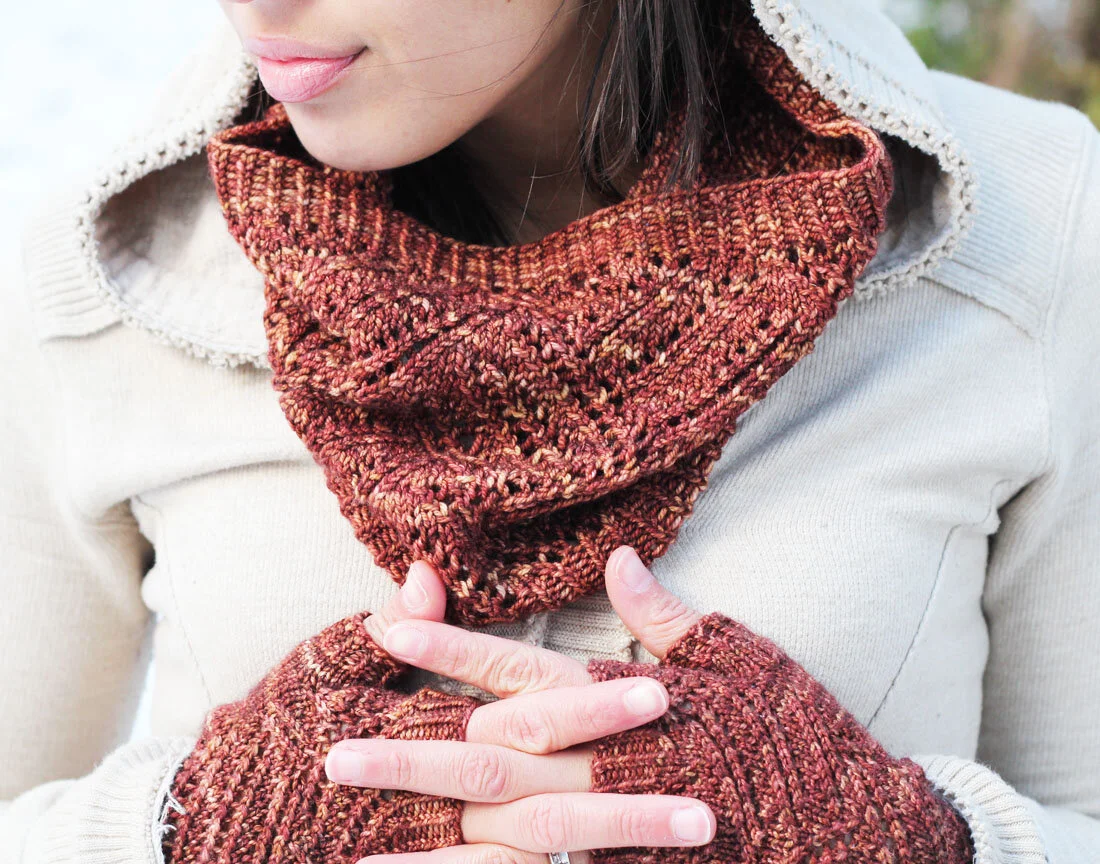
I cast on right away, using the dyer’s soft and luxurious MCN, a merino, cashmere, nylon blend. I wanted to create a set—a cowl and mitts that worked together but not as two separate projects. I made the first set in a teal colorway with earthy speckles, followed by a second set in a warm cinnamon. As I finished, I realized they’d each used exactly or just shy of one skein. That wasn’t by design; it just worked out that way.
The win came as such a validation. I was still so new to designing, and to have my work recognized alongside another designer’s? It gave me confidence to keep going and to trust that I had something to offer. I called it Dyade, a German word for a pair as well as a nod to my heritage and to how these two pieces were meant to function as one.
It’s a set that doesn't demand a big commitment—just one generous skein of fingering weight yarn in whatever color that speaks to you and a few evenings of knitting. You get to play with color and yarn and finish with something beautiful on your hands.

You know those days that start with spilled coffee on your desk and broken eggs on the kitchen floor? The kind where you just need easy, repetitive knitting and maybe some puppy snuggles to reset? That's exactly the kind of day I was having when I started working on Nydia.
Before that day, I’d already fallen in love with the addictive, potato-chip textured lace stitch from my Indira shawl and cowl—so easy to memorize you can practically knit it in your sleep. Once it got in my head I couldn't stop thinking, “What if I put this in a sweater?” So I did.
As this sweater became my go-to project through quiet evenings after long work days, it felt like finding comfort in my stitches. I could rely on the rhythm and familiarity of the repeat to melt away any stress or cares. The name Nydia—which means a safe place—felt right.
Nydia is a versatile pullover worked seamlessly from the top down in DK weight yarn with compound raglan shaping. It features a scoop neckline, but you can throw on the optional separate cowl to change up the look entirely. It's also cropped. (Yes, I know. My dad’s exact words were, "That’s a little short, baby . . ." when I showed him my second Nydia, and I had to assure him it's a thing.) But here's the beauty: you can totally make it longer if that’s more your style, and several knitters have!
This is the sweater you’ll reach for when you need something that just works—you just have a couple choices to make. So are you team cropped-with-cowl, or are you making it your own with a different length? I can’t wait to see.

In September 2018, I walked out of my local yarn shop with a sweater quantity of yarn and a familiar feeling. You know the one: that on-the-brink of starting something new, creative juices flowing, and endless possibilities feeling that only a maker can know. I didn’t have a pattern in mind, but I knew that this yarn would become something special.
Then something funny happened: I kept unintentionally sketching the same design. A pullover with cabled panels, a rounded neckline, “cold” shoulders, and set-in armholes appeared eight times, to be exact, on different days and in separate sketchbooks. It was almost as if the yarn was telling me, "This is what I want to be."
Now with a clear vision in mind, I started swatching. The yarn by itself was beautiful, soft, and airy with fantastic drape, but it lacked the cozy factor I was going for. When I paired it with a mohair/silk blend, the fabric transformed. It had depth and warmth, and it felt like kittens and clouds—exactly what I wanted.
In late 2019, I cast on and quickly realized that top-down construction wasn’t practical for the design I had sketched, so I restarted from the bottom up. When I tried it on for the first time, something was off. I frogged back and reknit the yoke. Still not right. I frogged again. And again. I couldn’t put my finger on what was wrong. All I know is that I was feeling pretty deflated. The yarn was practically begging me to stop frogging and reknitting it, and I needed a break.
Apparently, a three-year break.
Over those years, thoughts of “needing to finish that sweater” hung over my head. Would I ever finish? Had I failed? But while the sweater waited, I kept learning—about fit, grading, size inclusivity. I poured that knowledge into other patterns. And each time I released something new, I’d pull this sweater out with renewed determination. Yet I still didn’t have the answer.
It finally hit me in fall 2023. What if I changed everything? V-neck instead of scoop neck. Closed shoulders instead of open. Raglan sleeves instead of set-in. The revisions came together perfectly, and when I finally tried it on again . . . it worked!
This design challenged me more than any other. There was a span of time where I didn’t think I could finish it. But things got easier—things fell into place—when I stopped trying to force an idea and let the design take me where it wanted to go all along. In hindsight, it feels a little like serendipity.
It was, simply, “Meant to Vee.”