Meant to Vee







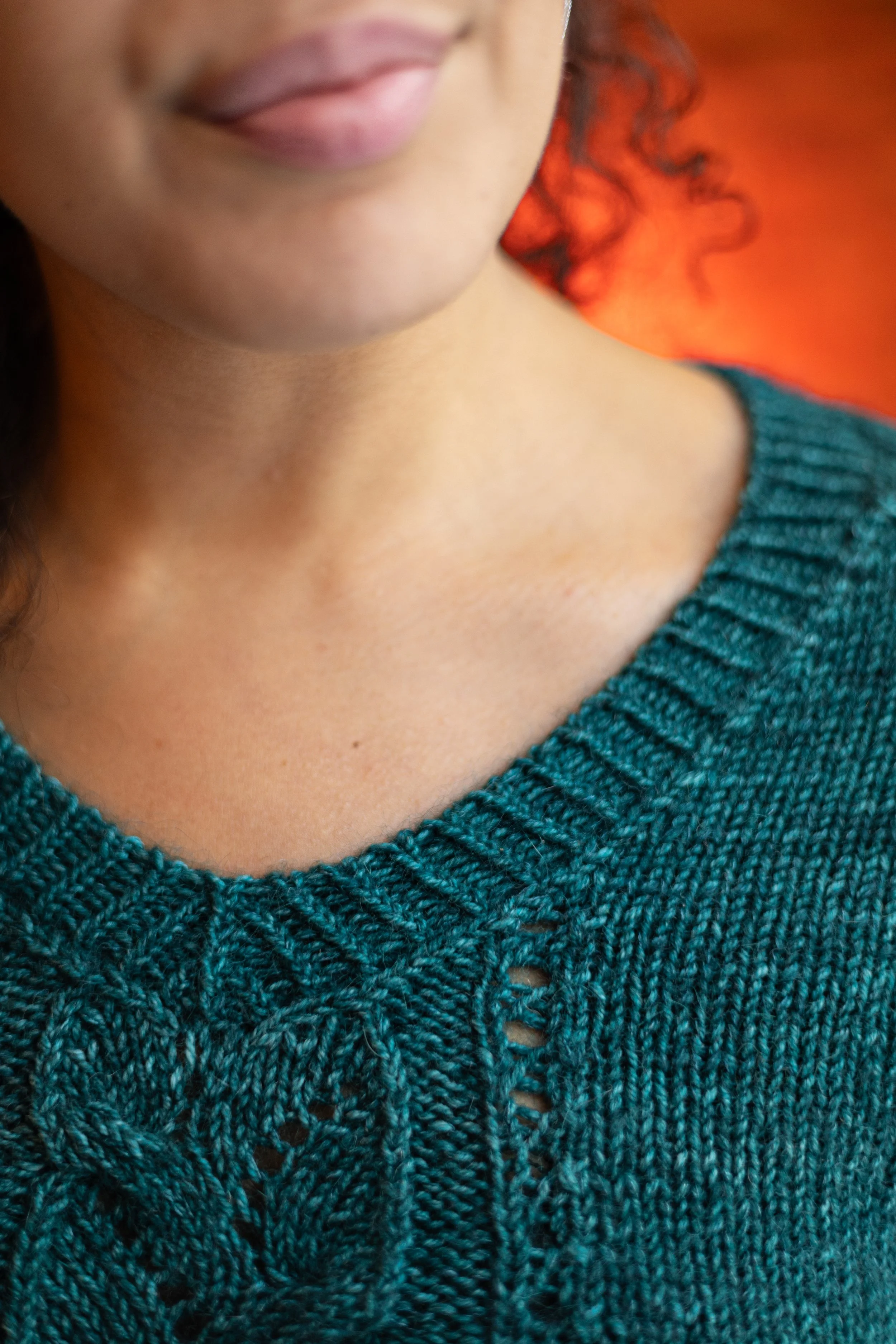
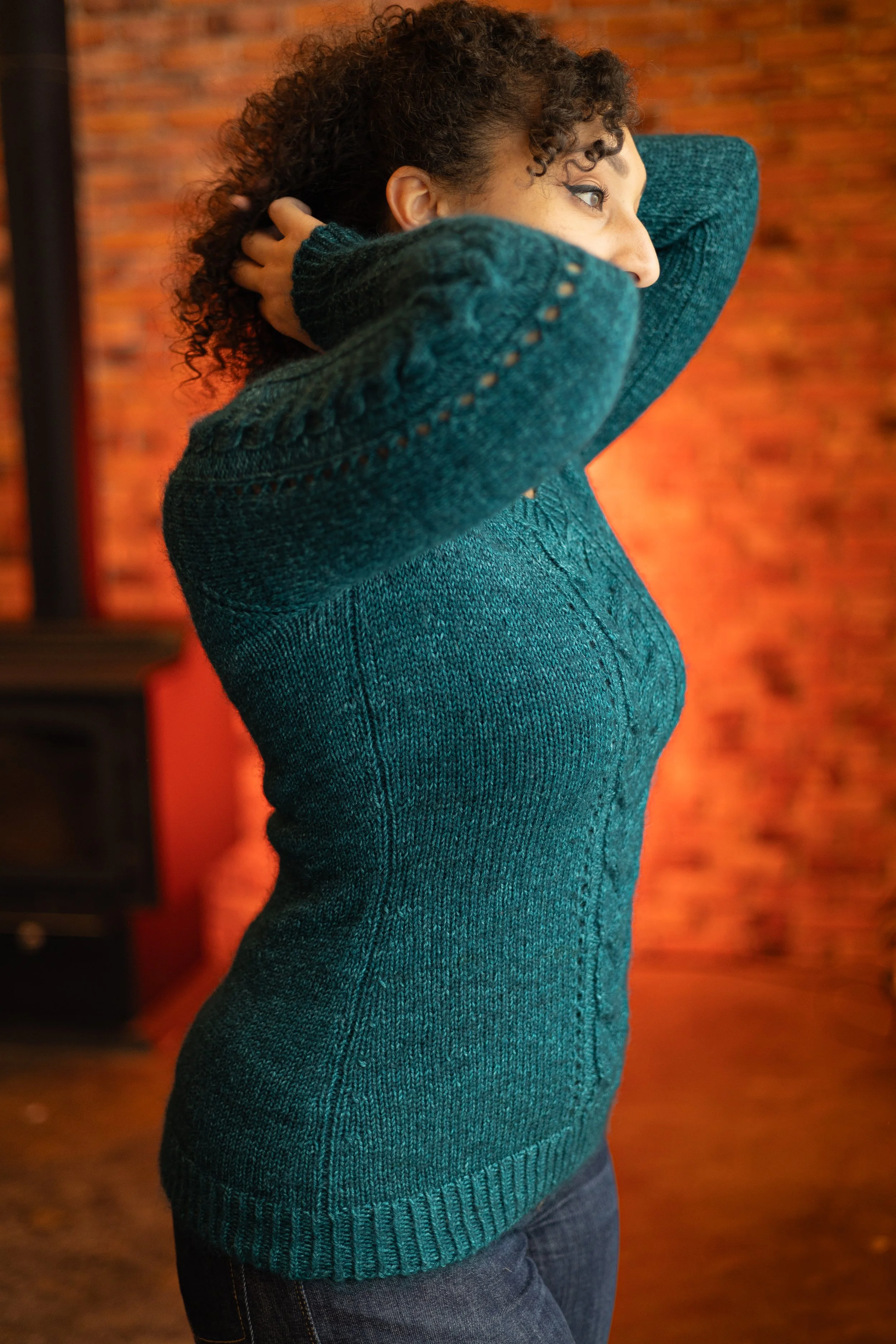
Meant to Vee
In September 2018, I walked out of my local yarn shop with a sweater quantity of yarn and a familiar feeling. You know the one: that on-the-brink of starting something new, creative juices flowing, and endless possibilities feeling that only a maker can know. I didn’t have a pattern in mind, but I knew that this yarn would become something special.
Then something funny happened: I kept unintentionally sketching the same design. A pullover with cabled panels, a rounded neckline, “cold” shoulders, and set-in armholes appeared eight times, to be exact, on different days and in separate sketchbooks. It was almost as if the yarn was telling me, "This is what I want to be."
Now with a clear vision in mind, I started swatching. The yarn by itself was beautiful, soft, and airy with fantastic drape, but it lacked the cozy factor I was going for. When I paired it with a mohair/silk blend, the fabric transformed. It had depth and warmth, and it felt like kittens and clouds—exactly what I wanted.
In late 2019, I cast on and quickly realized that top-down construction wasn’t practical for the design I had sketched, so I restarted from the bottom up. When I tried it on for the first time, something was off. I frogged back and reknit the yoke. Still not right. I frogged again. And again. I couldn’t put my finger on what was wrong. All I know is that I was feeling pretty deflated. The yarn was practically begging me to stop frogging and reknitting it, and I needed a break.
Apparently, a three-year break.
Over those years, thoughts of “needing to finish that sweater” hung over my head. Would I ever finish? Had I failed? But while the sweater waited, I kept learning—about fit, grading, size inclusivity. I poured that knowledge into other patterns. And each time I released something new, I’d pull this sweater out with renewed determination. Yet I still didn’t have the answer.
It finally hit me in fall 2023. What if I changed everything? V-neck instead of scoop neck. Closed shoulders instead of open. Raglan sleeves instead of set-in. The revisions came together perfectly, and when I finally tried it on again . . . it worked!
This design challenged me more than any other. There was a span of time where I didn’t think I could finish it. But things got easier—things fell into place—when I stopped trying to force an idea and let the design take me where it wanted to go all along. In hindsight, it feels a little like serendipity.
It was, simply, “Meant to Vee.”
Read the full behind-the-scenes story in this blog post →
What makes it special
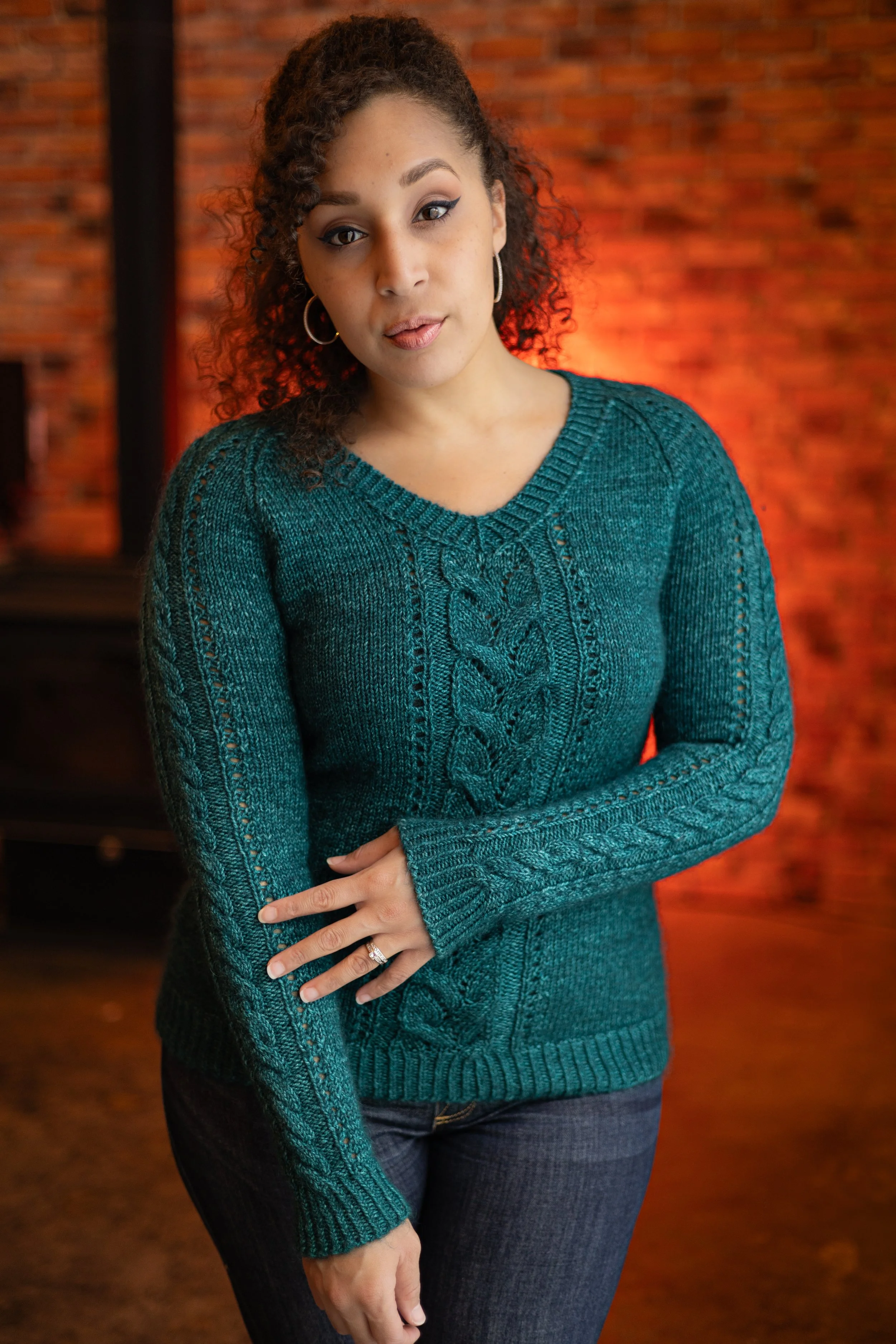
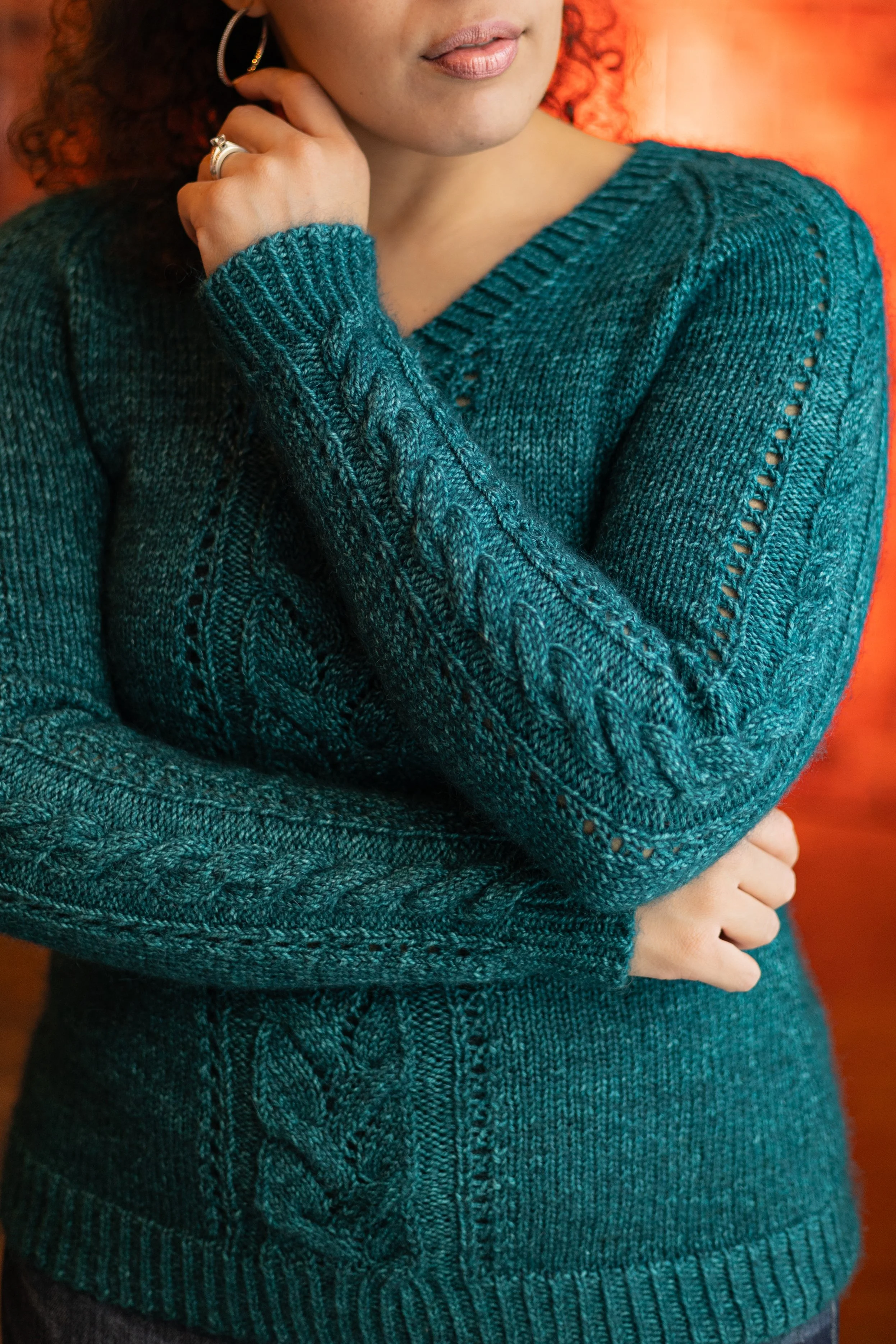
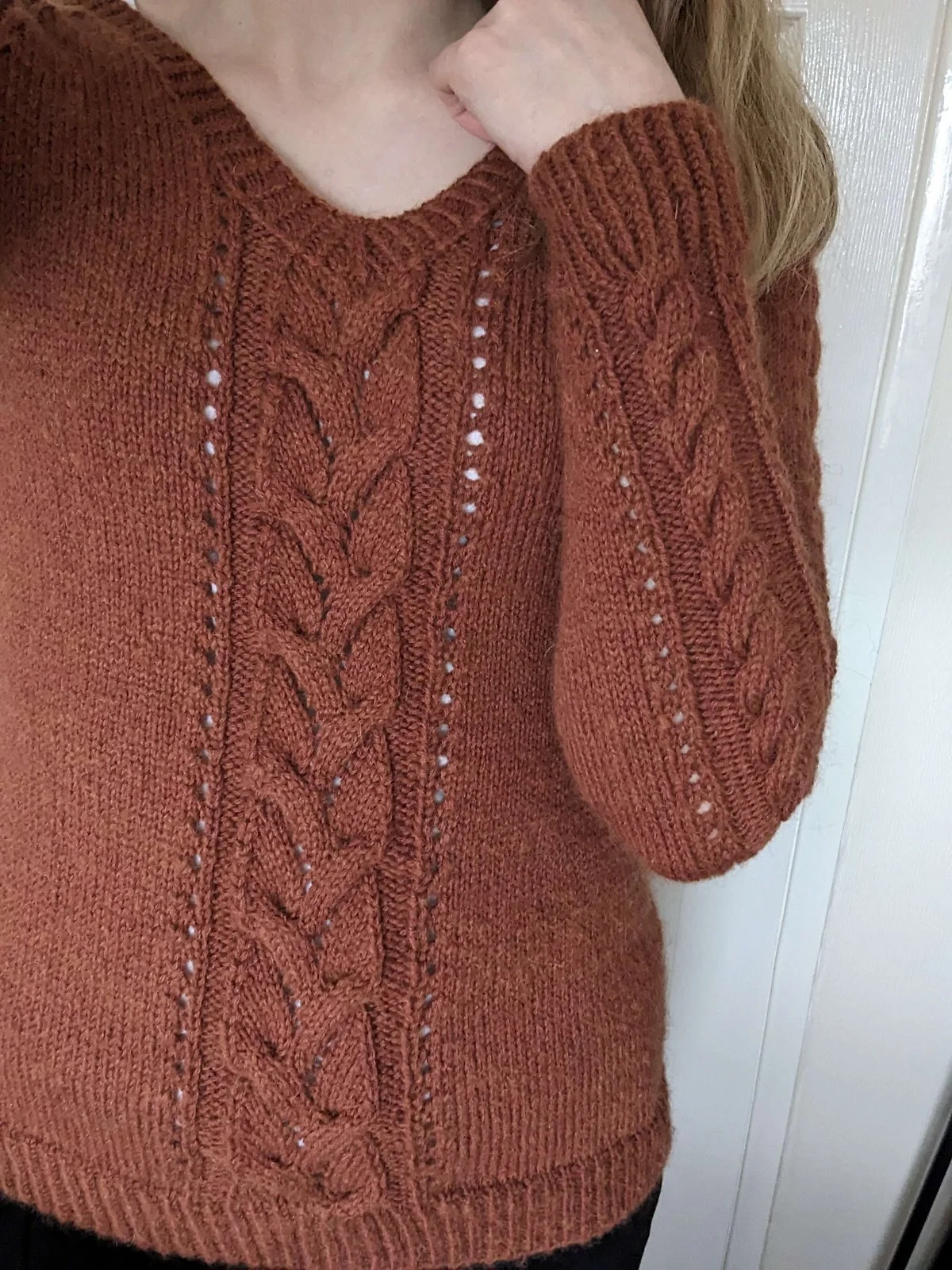
Cables and lace in balance. Textured cable and lace panels run down the center front and each sleeve. Simple stockinette on the sides keeps the pace manageable.
Size-inclusive, modular sizing. Pick different sizes for your bust, hips, and sleeves to create a sweater that fits you. Optional vertical and horizontal bust darts let you fine-tune the fit even further.
Shaping made simple. Interactive shaping trackers organize “at the same time” instructions so you don’t lose your place.
Plush, drapey fabric. DK held with lace mohair or worsted weight alone creates depth and warmth without bulk.
Seamless construction. Bottom-up raglan with only two grafted seams at the underarms.
For intermediate knitters. A satisfying project with a clear progression from sleeves through body to yoke.
💡 Want the same techniques, different silhouette? The Bestie Vestie uses the same central cable and lace panel, shaping, and bottom-up construction as Meant to Vee but in a sleeveless, shorter package.
Testermonials
“This was challenging and fun. Big plus, I actually have something I love and have been wearing..a lot! ”
“I volunteer to test-knit your sweater designs because I love your aesthetic and the way you handle body shaping. However, I am always rewarded with far more than a delightful finished product. I learn some cool new technique/tip/trick (or many) every time I do one of your test knits, and those are transferrable skills, worth their weight in gold.”
“I really enjoyed learning a new technique (bottom up sweater) and the way the pattern is written really gave me confidence to just jump in and do it. ”
“I love this sweater to bits! It was a rewarding knit- the FO fits so well! The construction was a bit more complex than what I have made in the past, but the pattern spells everything out so nicely and there are charts to help keep track of the cables along with the shaping.”
“My husband said this is the best thing I’ve ever made and I think I might agree with him! 🥰”

What’s included
Instant PDF download – Fully written instructions, charts, and detailed schematics.
13 sizes, properly graded to fit real bodies – Finished bust circumferences ranging 26.5–63.5” or 66.5–158.5 cm.
Video support – Step-by-step tutorials for key techniques so you can reference them as needed.
Detailed fit customization guidance – Worksheets and comprehensive directions make modifying lengths or mix and matching hip, bust, and sleeve sizes easy.
Interactive shaping trackers – Track your progress through increases and decreases and always remember where you left off.
Optional bust darts – Instructions for vertical and horizontal bust darts for a truly personalized, custom-fit sweater.
I talk all about this pattern and what it includes in this YouTube video:
It’s meant for you.
In September 2018, I walked out of my local yarn shop with a sweater quantity of yarn and a familiar feeling. You know the one: that on-the-brink of starting something new, creative juices flowing, and endless possibilities feeling that only a maker can know. I didn’t have a pattern in mind, but I knew that this yarn would become something special.
Then something funny happened: I kept unintentionally sketching the same design. A pullover with cabled panels, a rounded neckline, “cold” shoulders, and set-in armholes appeared eight times, to be exact, on different days and in separate sketchbooks. It was almost as if the yarn was telling me, "This is what I want to be."
Now with a clear vision in mind, I started swatching. The yarn by itself was beautiful, soft, and airy with fantastic drape, but it lacked the cozy factor I was going for. When I paired it with a mohair/silk blend, the fabric transformed. It had depth and warmth, and it felt like kittens and clouds—exactly what I wanted.
In late 2019, I cast on and quickly realized that top-down construction wasn’t practical for the design I had sketched, so I restarted from the bottom up. When I tried it on for the first time, something was off. I frogged back and reknit the yoke. Still not right. I frogged again. And again. I couldn’t put my finger on what was wrong. All I know is that I was feeling pretty deflated. The yarn was practically begging me to stop frogging and reknitting it, and I needed a break.
Apparently, a three-year break.
Over those years, thoughts of “needing to finish that sweater” hung over my head. Would I ever finish? Had I failed? But while the sweater waited, I kept learning—about fit, grading, size inclusivity. I poured that knowledge into other patterns. And each time I released something new, I’d pull this sweater out with renewed determination. Yet I still didn’t have the answer.
It finally hit me in fall 2023. What if I changed everything? V-neck instead of scoop neck. Closed shoulders instead of open. Raglan sleeves instead of set-in. The revisions came together perfectly, and when I finally tried it on again . . . it worked!
This design challenged me more than any other. There was a span of time where I didn’t think I could finish it. But things got easier—things fell into place—when I stopped trying to force an idea and let the design take me where it wanted to go all along. In hindsight, it feels a little like serendipity.
It was, simply, “Meant to Vee.”
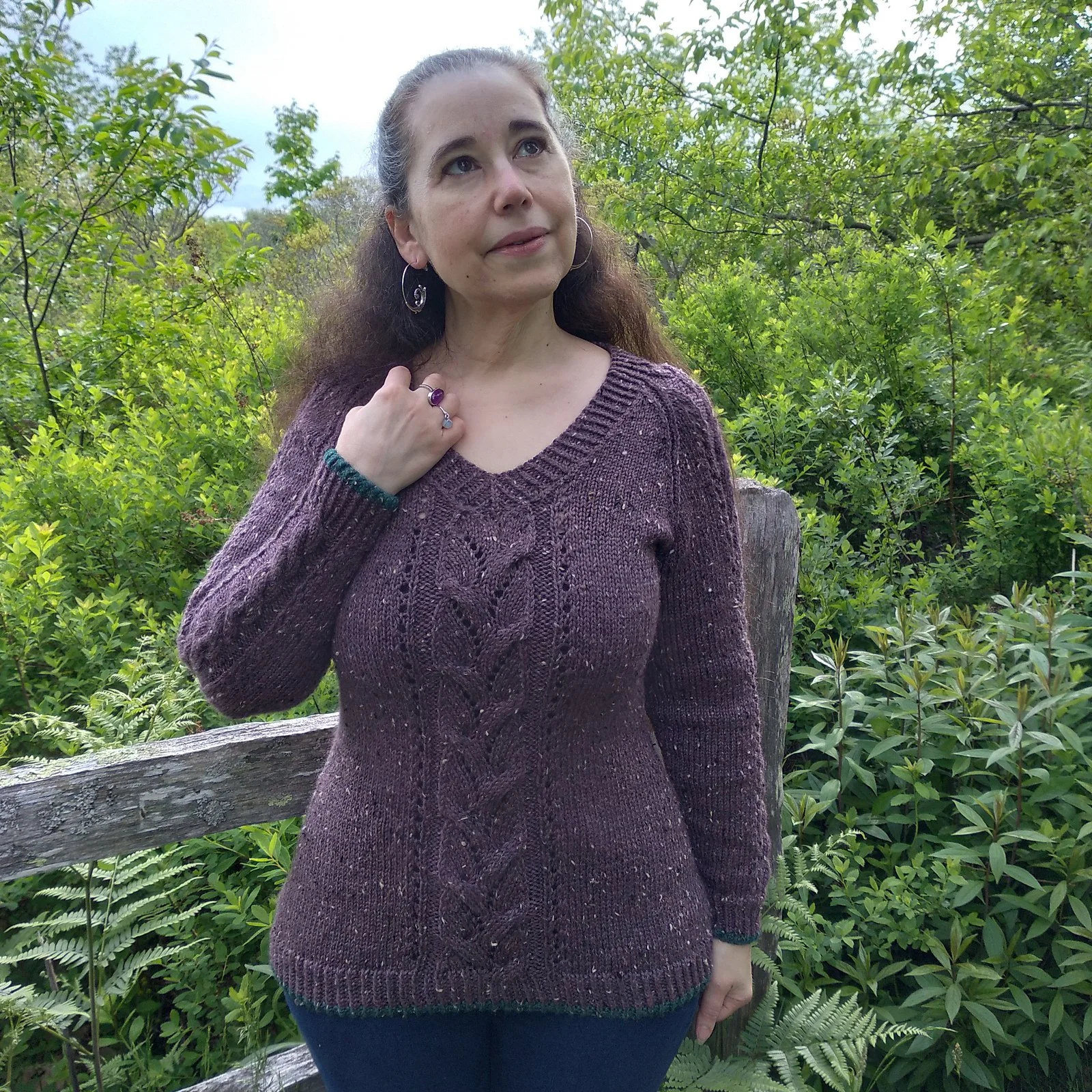
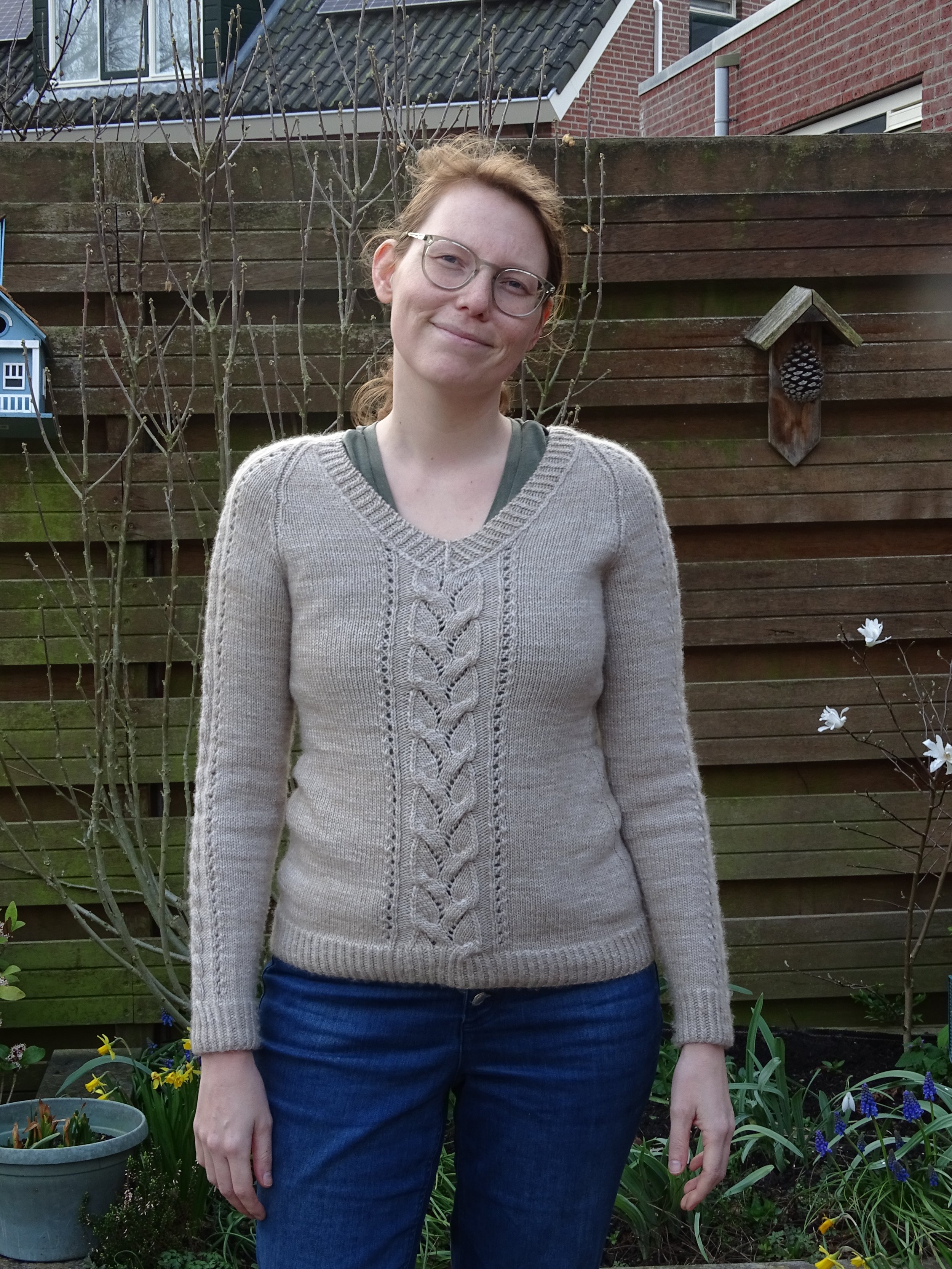
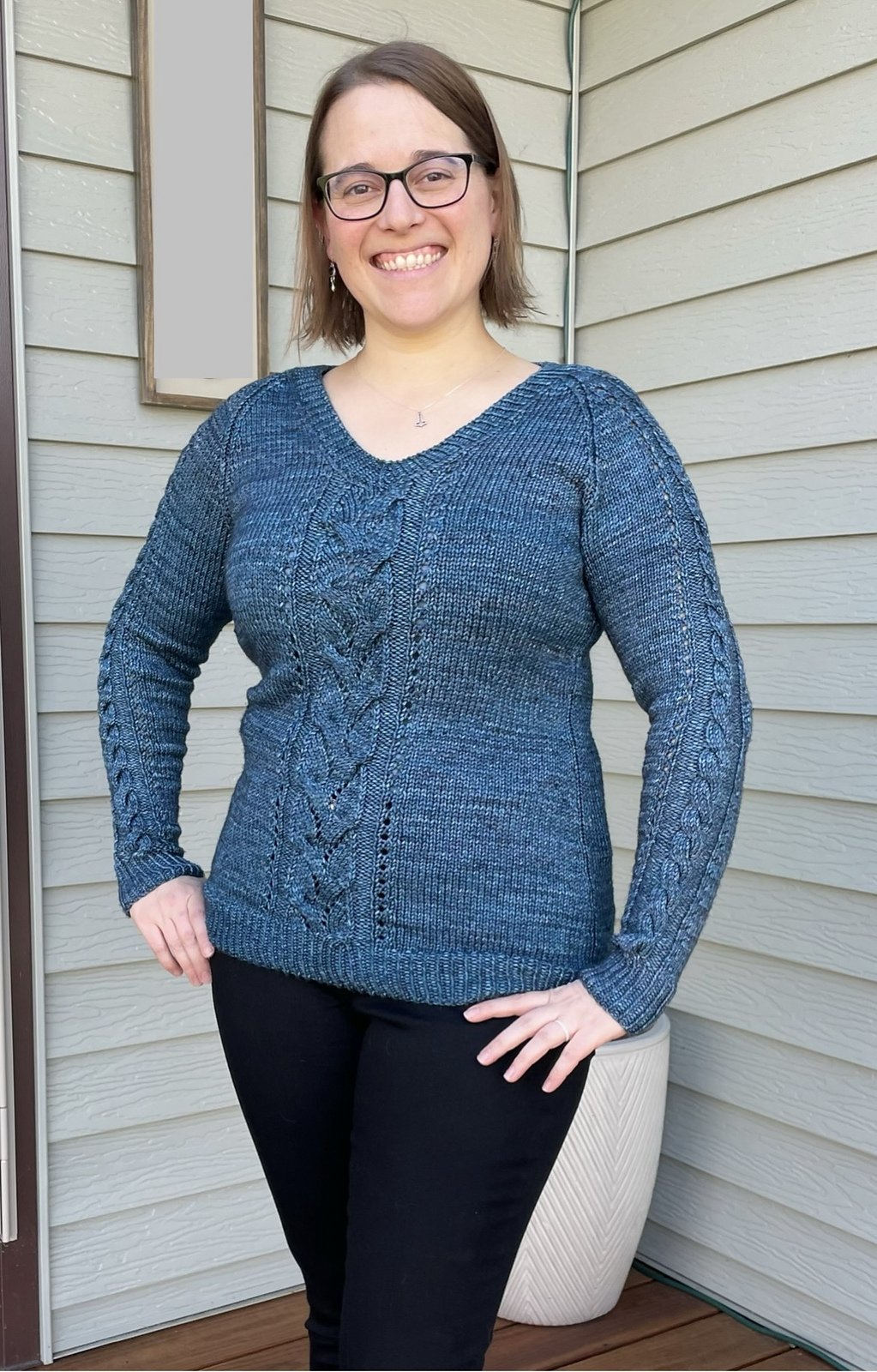
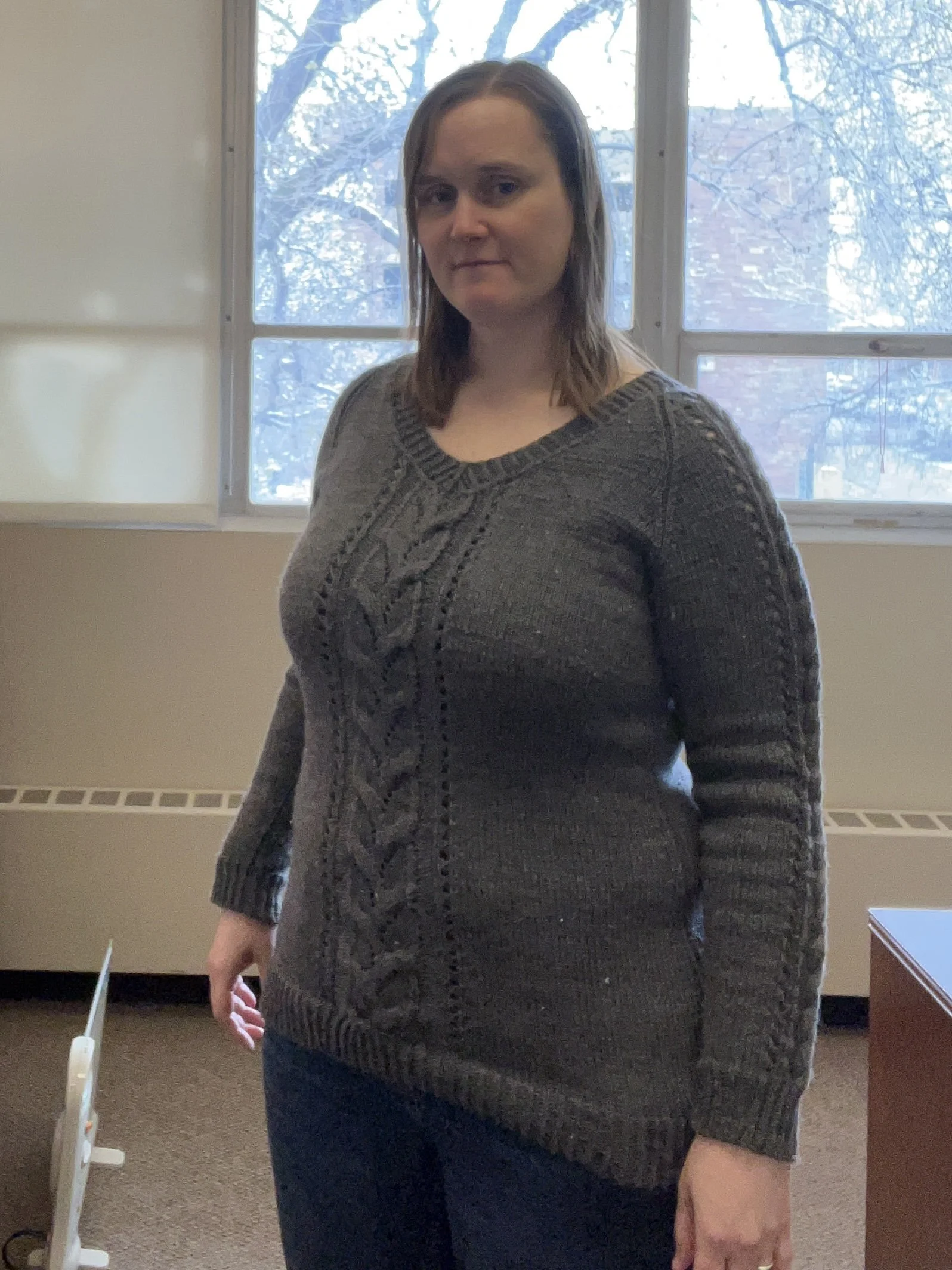
Test Knitter Photo Gallery
Thank you to the many test knitters who helped bring this pattern to life! 💕 Below is a gallery of some of their beautiful sweaters, shown in alphabetical order by their Ravelry usernames unless otherwise noted. Click or tap the photos to enlarge them and scroll through.


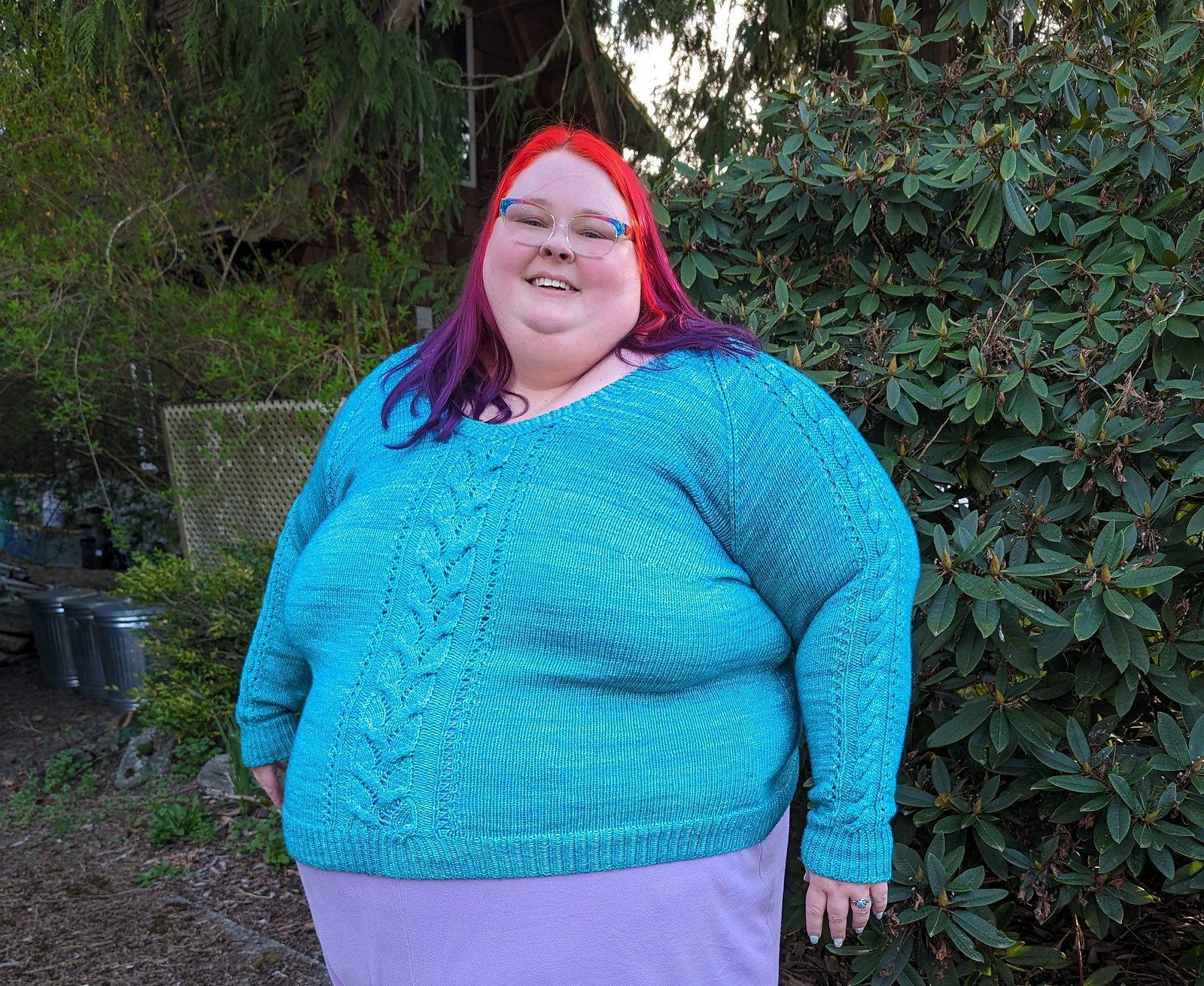


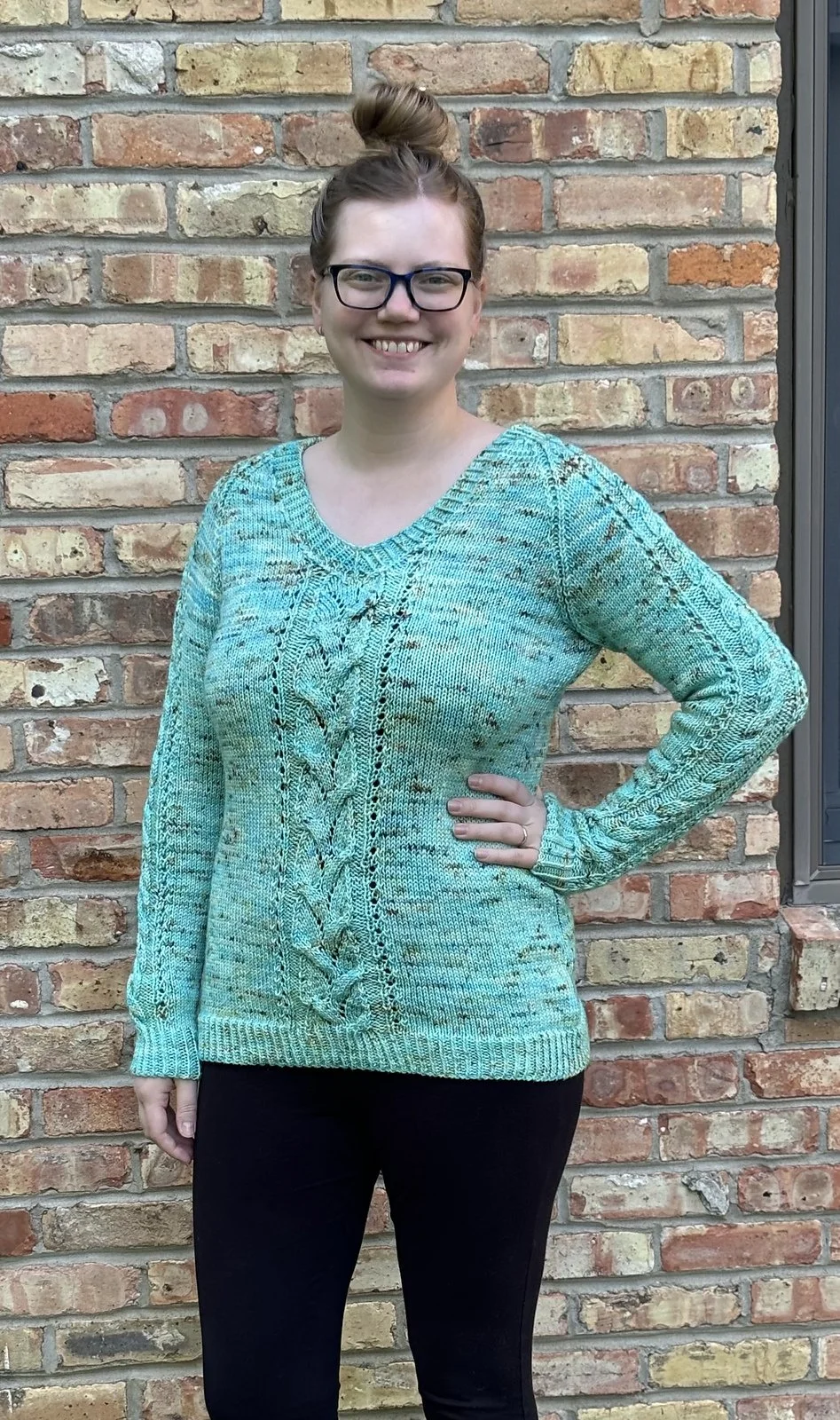









The Knitty-Gritty
Description
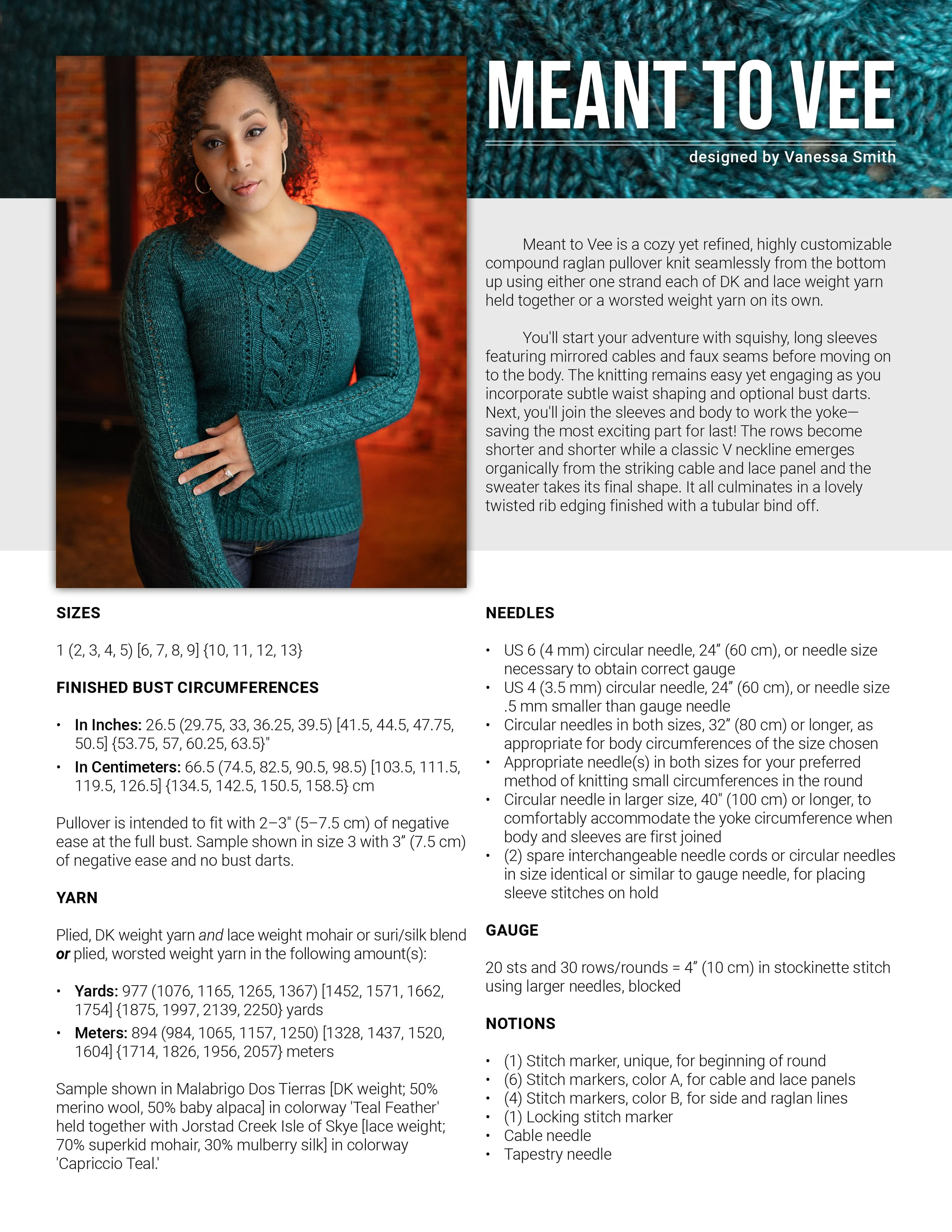
Meant to Vee is a cozy yet refined, highly customizable compound raglan pullover knit seamlessly from the bottom up using either one strand each of DK and lace weight yarn held together or a worsted weight yarn on its own.
You'll start your adventure with squishy, long sleeves featuring mirrored cables and faux seams before moving on to the body. The knitting remains easy yet engaging as you incorporate subtle waist shaping and optional bust darts. Next, you'll join the sleeves and body to work the yoke—saving the most exciting part for last! The rows become shorter and shorter while a classic V neckline emerges organically from the striking cable and lace panel and the sweater takes its final shape. It all culminates in a lovely twisted rib edging finished with a tubular bind off.
Sizes
1 (2, 3, 4, 5) [6, 7, 8, 9] {10, 11, 12, 13}
Finished Bust Circumferences
In Inches: 26.5 (29.75, 33, 36.25, 39.5) [41.5, 44.5, 47.75, 50.5] {53.75, 57, 60.25, 63.5}"
In Centimeters: 66.5 (74.5, 82.5, 90.5, 98.5) [103.5, 111.5, 119.5, 126.5] {134.5, 142.5, 150.5, 158.5} cm
Pullover is intended to fit with 2–3" (5–7.5 cm) of negative ease at the full bust. Sample shown in size 3 with 3” (7.5 cm) of negative ease and no bust darts.
Yarn
Plied, DK weight yarn and lace weight mohair or suri/silk blend or plied, worsted weight yarn in the following amount(s):
Yards: 977 (1076, 1165, 1265, 1367) [1452, 1571, 1662, 1754] {1875, 1997, 2139, 2250} yards
Meters: 894 (984, 1065, 1157, 1250) [1328, 1437, 1520, 1604] {1714, 1826, 1956, 2057} meters
Sample shown in Malabrigo Dos Tierras [DK weight; 50% merino wool, 50% baby alpaca] in colorway 'Teal Feather' held together with Jorstad Creek Isle of Skye [lace weight; 70% superkid mohair, 30% mulberry silk] in colorway 'Capriccio Teal.'
Needles
US 6 (4 mm) circular needle, 24” (60 cm), or needle size necessary to obtain correct gauge
US 4 (3.5 mm) circular needle, 24” (60 cm), or needle size .5 mm smaller than gauge needle
Circular needles in both sizes, 32” (80 cm) or longer, as appropriate for body circumferences of the size chosen
Appropriate needle(s) in both sizes for your preferred method of knitting small circumferences in the round
Circular needle in larger size, 40" (100 cm) or longer, to comfortably accommodate the yoke circumference when body and sleeves are first joined
(2) spare interchangeable needle cords or circular needles in size identical or similar to gauge needle, for placing sleeve stitches on hold
Gauge
20 sts and 30 rows/rounds = 4” (10 cm) in stockinette stitch using larger needles, blocked
Notions
(1) Stitch marker, unique, for beginning of round
(6) Stitch markers, color A, for cable and lace panels
(4) Stitch markers, color B, for side and raglan lines
(1) Locking stitch marker
Cable needle
Tapestry needle
Make this sweater your own.
In September 2018, I walked out of my local yarn shop with a sweater quantity of yarn and a familiar feeling. You know the one: that on-the-brink of starting something new, creative juices flowing, and endless possibilities feeling that only a maker can know. I didn’t have a pattern in mind, but I knew that this yarn would become something special.
Then something funny happened: I kept unintentionally sketching the same design. A pullover with cabled panels, a rounded neckline, “cold” shoulders, and set-in armholes appeared eight times, to be exact, on different days and in separate sketchbooks. It was almost as if the yarn was telling me, "This is what I want to be."
Now with a clear vision in mind, I started swatching. The yarn by itself was beautiful, soft, and airy with fantastic drape, but it lacked the cozy factor I was going for. When I paired it with a mohair/silk blend, the fabric transformed. It had depth and warmth, and it felt like kittens and clouds—exactly what I wanted.
In late 2019, I cast on and quickly realized that top-down construction wasn’t practical for the design I had sketched, so I restarted from the bottom up. When I tried it on for the first time, something was off. I frogged back and reknit the yoke. Still not right. I frogged again. And again. I couldn’t put my finger on what was wrong. All I know is that I was feeling pretty deflated. The yarn was practically begging me to stop frogging and reknitting it, and I needed a break.
Apparently, a three-year break.
Over those years, thoughts of “needing to finish that sweater” hung over my head. Would I ever finish? Had I failed? But while the sweater waited, I kept learning—about fit, grading, size inclusivity. I poured that knowledge into other patterns. And each time I released something new, I’d pull this sweater out with renewed determination. Yet I still didn’t have the answer.
It finally hit me in fall 2023. What if I changed everything? V-neck instead of scoop neck. Closed shoulders instead of open. Raglan sleeves instead of set-in. The revisions came together perfectly, and when I finally tried it on again . . . it worked!
This design challenged me more than any other. There was a span of time where I didn’t think I could finish it. But things got easier—things fell into place—when I stopped trying to force an idea and let the design take me where it wanted to go all along. In hindsight, it feels a little like serendipity.
It was, simply, “Meant to Vee.”
Buy it on Ravelry.
You may also like . . .

Is there a type of garment that you haven’t made yet? Perhaps you've never knitted (or worn!) a vest before. Or maybe you’ve already made a few and you’re looking for a pattern that feels fresh—something quick, transitional, and size-inclusive for the season ahead.
I was in the first camp when I tuned into an Instagram Live one afternoon, where two besties talked all about a vest-along they were about to participate in. As they excitedly chatted about silhouettes, textures, and how they’d style a vest, I couldn't think about anything else. Before the live even ended, I’d grabbed the nearest notepad and scribbled a few rough sketches based on another pattern I had in test knitting at the time.
The first sketch was heavily cabled, front and back. “Keep it simple!”, I thought to myself. But it was the third sketch—the last one on that notepad—that stood out as “the one.”
I started a spreadsheet and ordered yarn faster than it took you to read this sentence. One package was coming from another state, the other from a couple hours north of me. Tracking said nearly a week. Torture!
To my relief, the yarn arrived four days sooner than estimated, and just in time for me to work on it while podcasting and watching You’ve Got Mail with my own bestie during her visit from Canada. There’s something special about knitting with someone you love in the room, even if you’re both just doing your own thing.
As I made progress on the pattern and then worked on a second sample, my husband—completely unaware of what (or who!) had inspired me to drop everything else—started calling it the Bestie Vestie. I loved how that name rolled off the tongue. It was cute, memorable, and different from anything I’ve named before.
The icing on the cake: 90 test knitters helped bring this pattern to life, and so many of them said the same thing—this is the best-fitting thing they’ve ever made. If you decide to make one too, whether as your first vest or a new one to add to a growing collection, I hope that it’s your Bestie Vestie yet.

Back in 2011, I set out to design the sweater I wished I had when I first started knitting garments. I wanted something stunning but approachable. Something that looked intricate but was secretly easy to make. A pattern that could help knitters take that big, scary leap into sweater-making without feeling left in the dark.
That’s how Julissa—my very first garment pattern—was born. It’s a top-down, beautifully detailed, boat neck raglan pullover that quickly became the first-ever sweater for so many knitters. But just like every knitter evolves, so do patterns.
Fast forward 10 years to 2021, and I knew Julissa deserved more. In that decade, I had learned so much about fit, shaping, finishing techniques, and how to make my knitting patterns more intuitive. I cared about this design too much to leave it in the past, so I completely updated it with everything I’d learned:
Expanded size range to meet today’s size-inclusivity standards
More refined shaping for the neckline and larger busts
Extra guidance on customization for different body types and fit preferences
Detailed explanations and links to video tutorials for professional shaping and finishing techniques
More printer-friendly and interactive
This pattern is an oldie but a goodie; a legacy piece that has grown and improved right alongside me and the knitters who’ve made it. Ready to become a part of its history?

After I released the Indira shawl, I wore it everywhere—to work, knit nights, a winter wedding. Anywhere I wanted elegance without overthinking it. But in some settings, like around my office, I realized a smaller accessory would be more practical. I found myself wanting something I could throw on and that would stay put. A cowl with the same stitch patterns felt perfect, so I started sketching.
The size and shape were crucial. I wanted the same beautiful drape as the shawl and decided to make the cowl wider at the base, narrower at the top. I also wanted to knit as much of that striking double-braided cable as possible. Sideways construction was the answer. It gave me the opportunity to play with short rows, which I’d been wanting to explore more, and to include not just one but two cables! The fun part was problem-solving and figuring out how to execute it so the pattern would be repeatable. When I finally drew a short-row diagram that looked promising, I circled it and wrote, “This works!”
I knit two prototypes to test the construction. The first was too narrow at the top and never saw the light of day. The second one was where things clicked. I was amazed to see the short rows work exactly as I’d sketched them, creating that perfect funnel shape. This sample needed some fine-tuning, but it quickly became part of my knitwear rotation too.
Once the design came together, finding the perfect yarn was next. A bold, dark red colorway in La Bien Aimée’s catalog stood out as the one. I savored every stitch from cast on to bind off, and I was especially excited to be able to wear my finished cowl when meeting Aimée for the first time at Stitches West 2020.
I’ve made two more Indira Cowls since then, including one in yellow for La Bien Aimée’s boutique in Paris, and I constantly reach for any one of the three I still have. It’s exactly the kind of accessory I was looking for—elegant, practical, wearable. Maybe it’s what you’ve been looking for too.