Novemberist Hat


Novemberist Hat
There are hats you make because you need a hat. And then there’s the Novemberist—a hat with a story behind it.
November 2018 felt like it held multiple lifetimes. That month, I had my first trunk show at a local yarn shop, where I picked up two yarns for a hat design I had brewing. Then my husband Cody, his little cousin, and I took our first trip to Victoria, British Columbia, to explore the city, catch live music, and enjoy great food. And after all that, I attempted something I'd never done before: stranded colorwork.
The design process was playful and exciting. I developed three chevron charts, swatched two, and chose one for this pattern—the other would later become my Kestra Hat. While making the very first hat in the colors I'd chosen at the LYS, I learned to keep my floats relaxed, to catch them properly, and to maintain the right color dominance. It was awkward and fun, using both my hands together in a way that was entirely new.
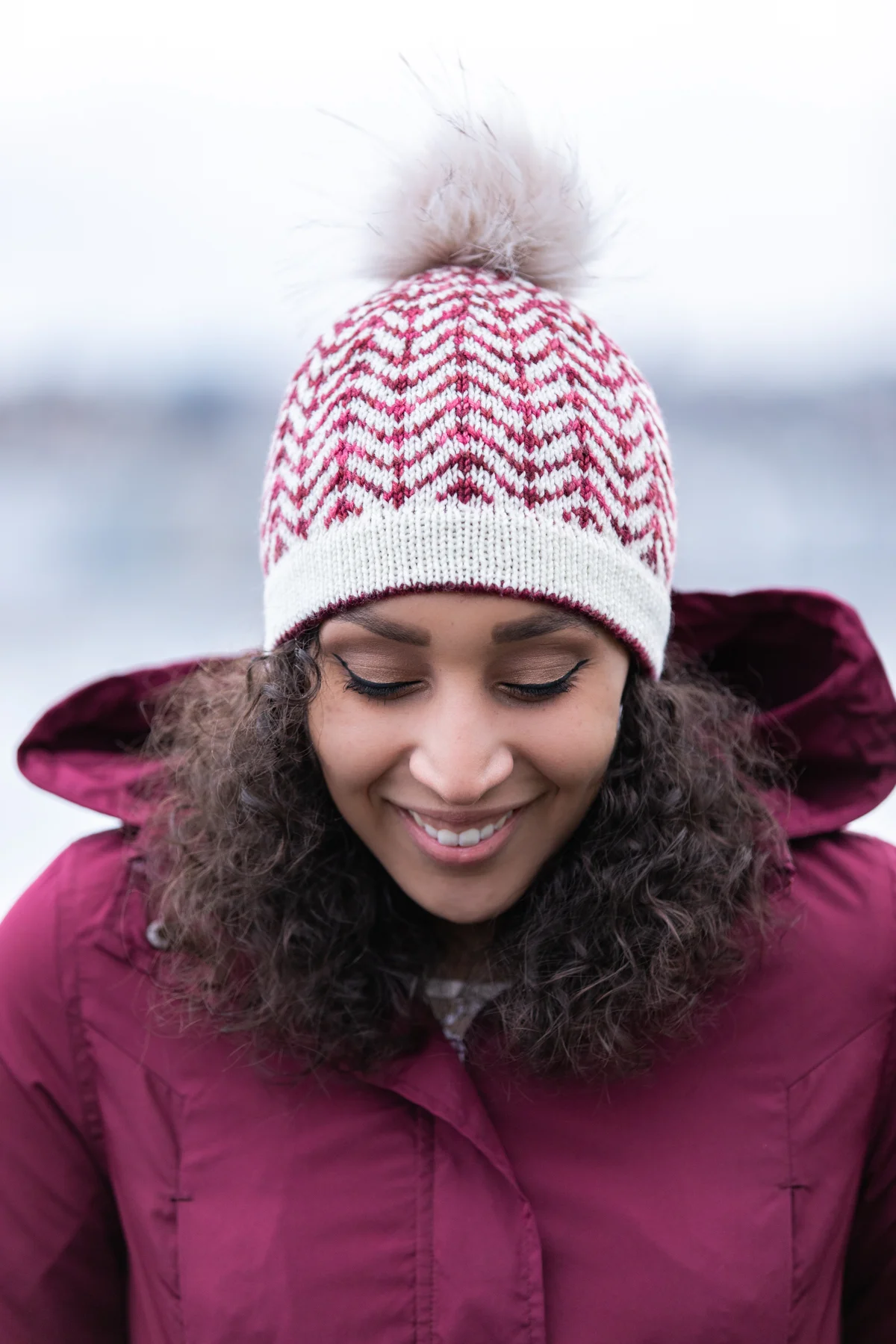
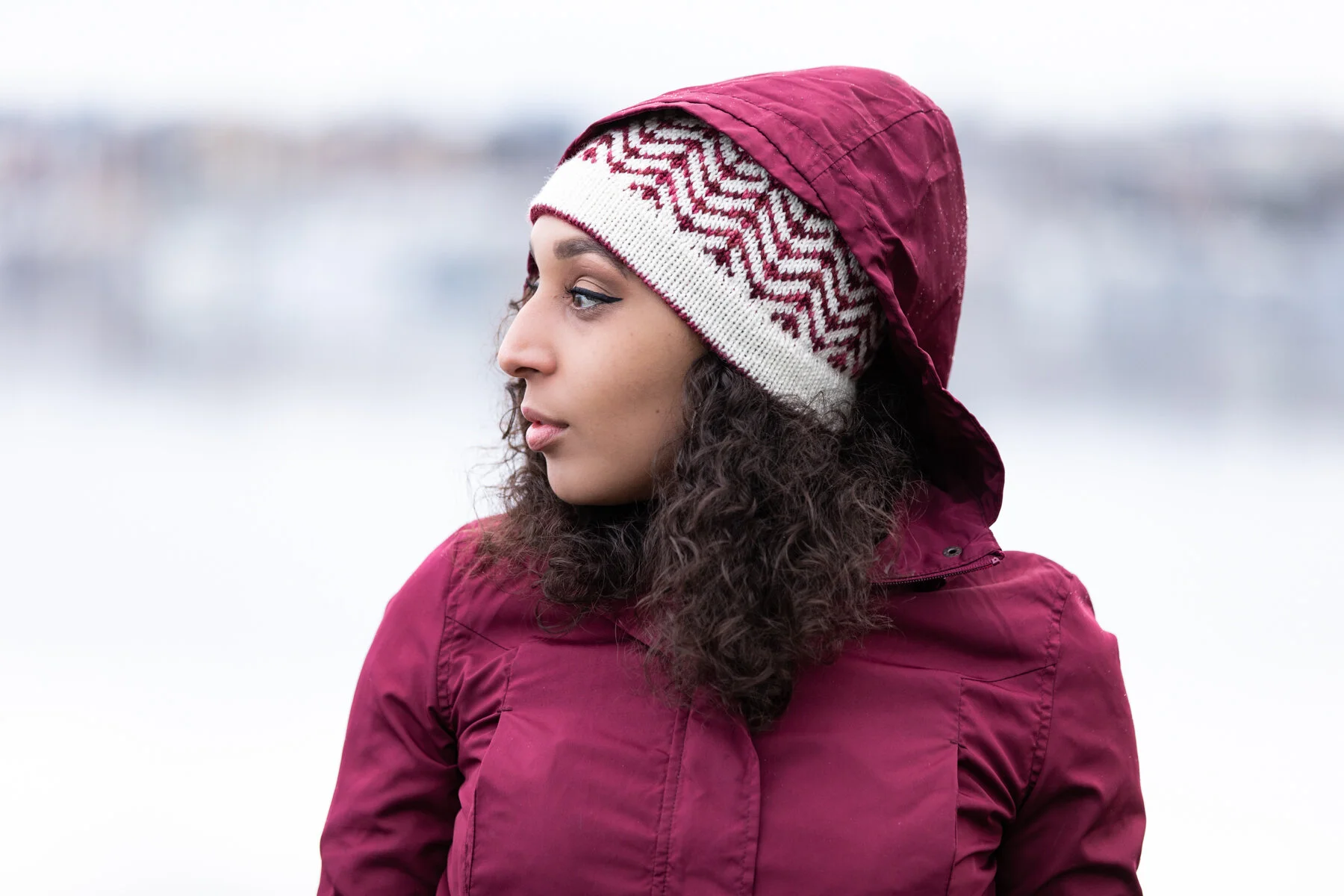
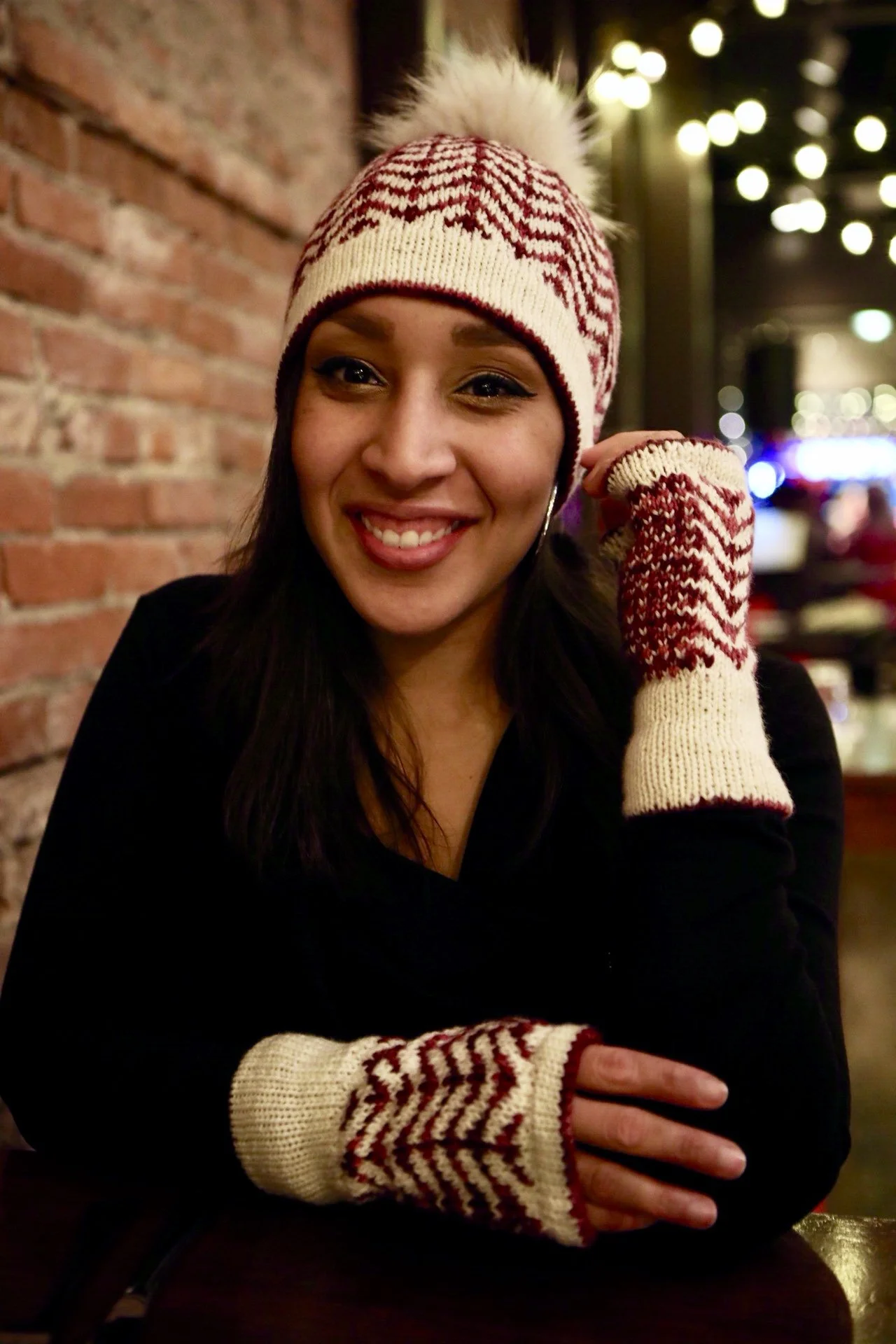
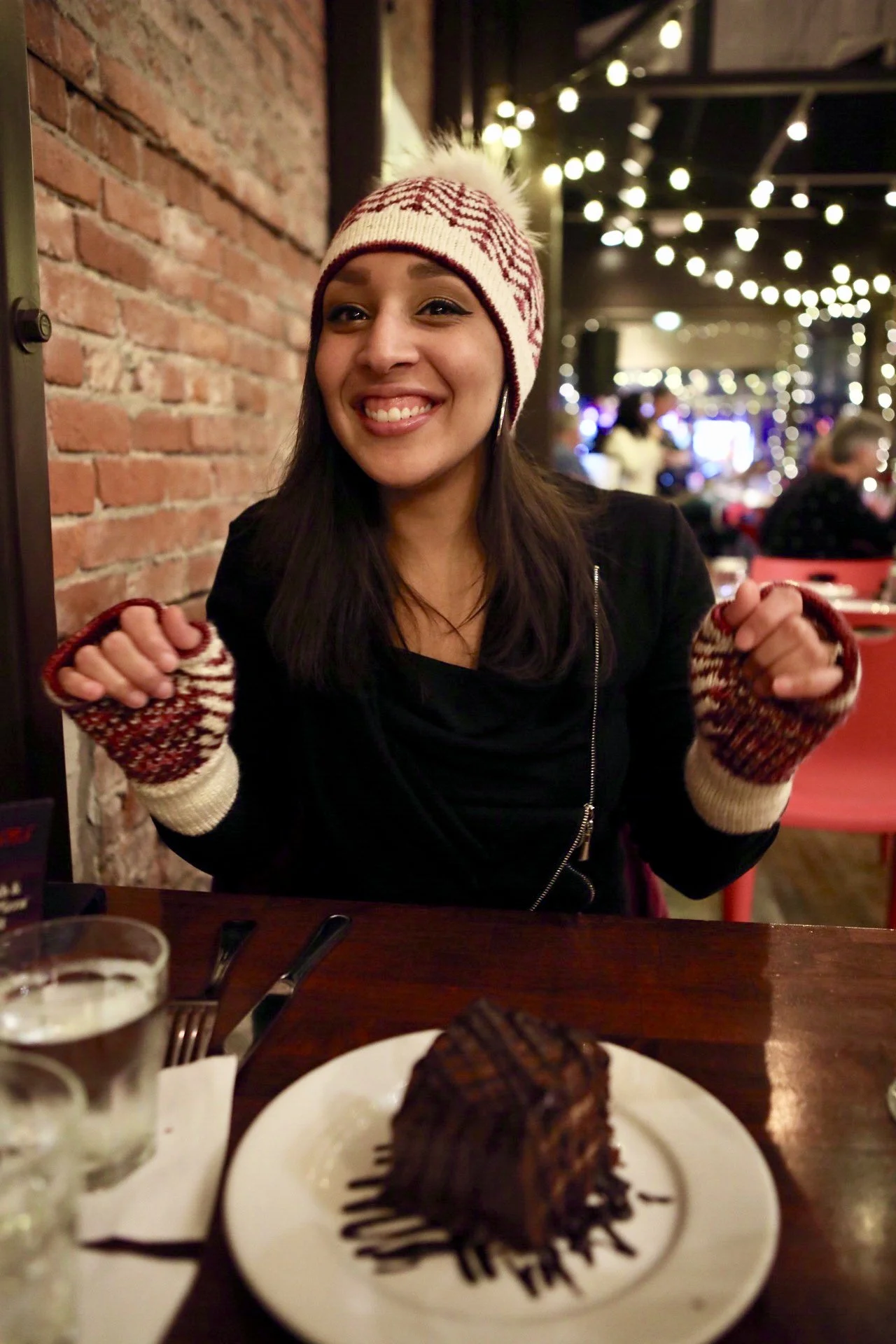
For the final sample, Cody helped me choose colors from my stash: a warm red with rust and strawberry undertones for the chevrons, paired with natural for the background. I made the brim doubly thick, both for warmth and because I loved how a pop of color would peek out from beneath it. I'd done something similar on another hat pattern called Corbin, and I really loved the look.
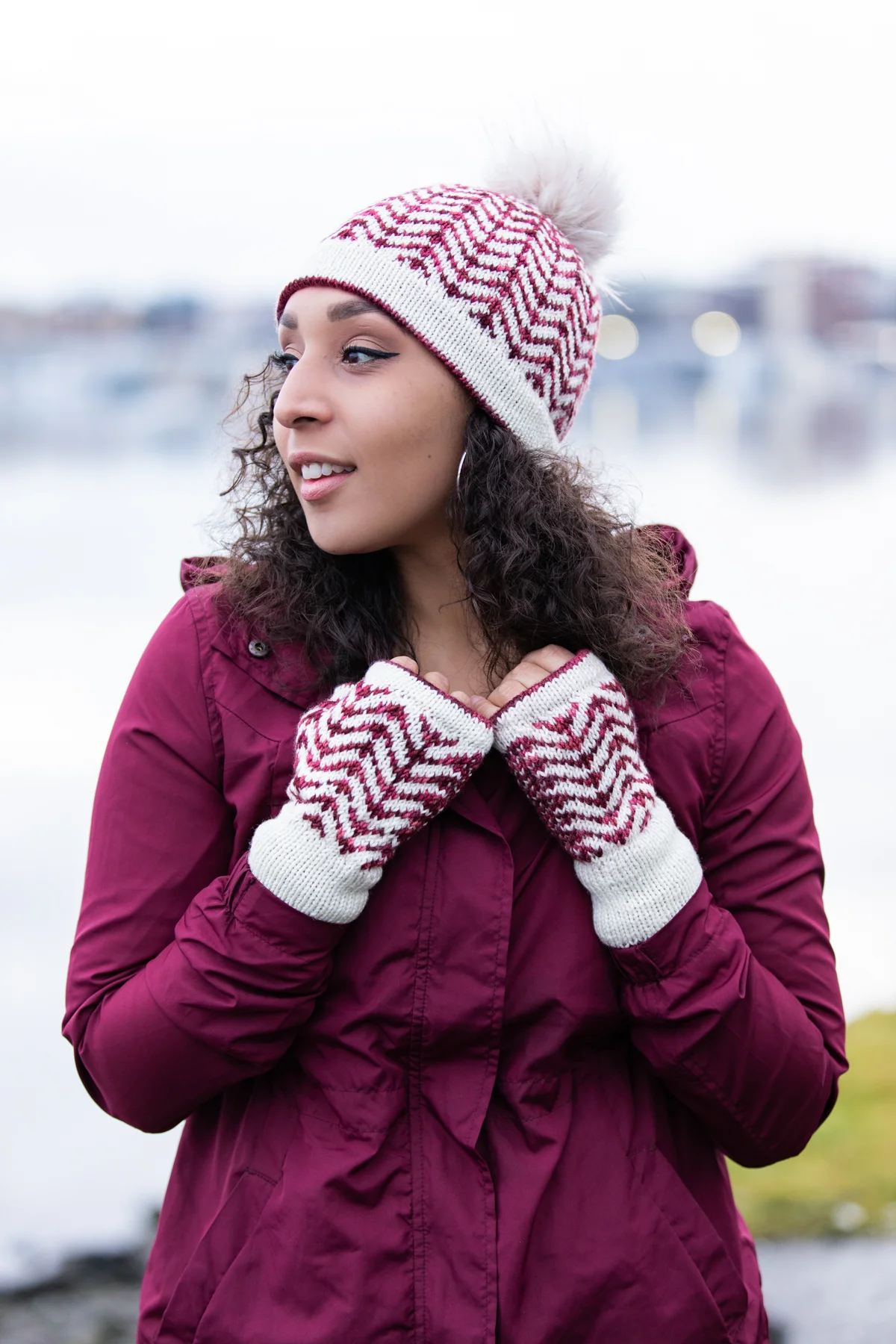
The hat that emerged from that memorable month became part of the Novemberist set, a hat and mitt pairing that’s waiting to become part of your story too. What will your November look like?
What makes it special
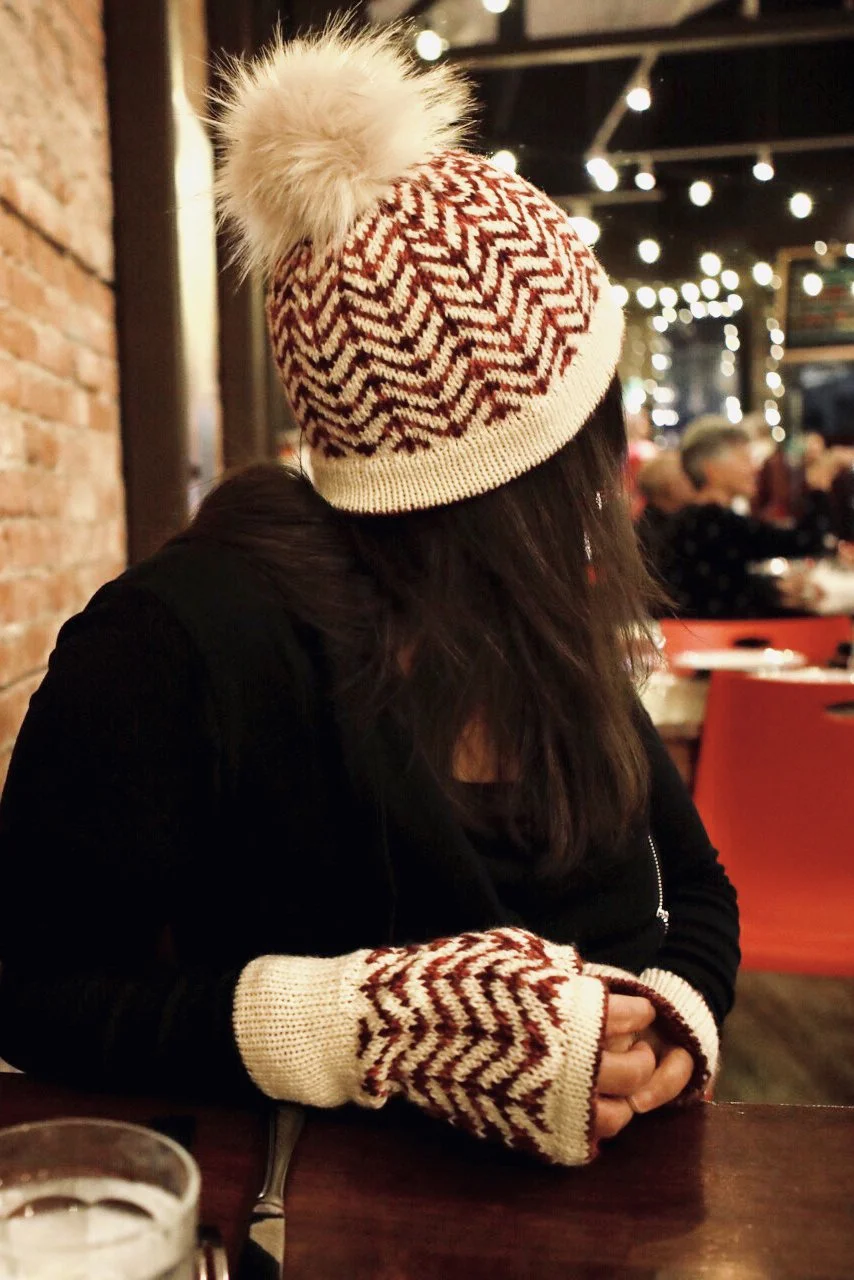
Two-color stranded colorwork with a clear repeat. The main chevron pattern is straightforward and easy to memorize without constantly checking a chart. Decreases are then worked in the colorwork for a unique pinwheel effect.
A turned brim that finishes itself. Start with a provisional cast on then knit one layer in stockinette, change colors, knit another. Your contrast color shows along the bottom edge for a detail that’s already baked into the construction and a fun pop of color.
Doubled thickness throughout. Two layers of fabric from the doubled brim plus the floats running through the colorwork mean genuine warmth and structure.
Quick to finish. DK weight, simple structure, done in a few knitting sessions.
What other knitters have said
“The last one is so awesome I decided to make a second in black and red. . . . Very pleased, it is a great pattern, it comes down low on my head in a good way and is very warm.”
“I was slightly skeptical about the non-ribbed brim, but the hat fits perfectly and is super cozy!”
“The turned hem is a dream! And this yarn is soft as can be. I loved every second of knitting this hat. Will absolutely make again!”
“Super cute color work hat!! I love the folded brim with the contrast color peeking out. Used fingering held double with light worsted Rios and got gauge bang on! Thanks Vanessa for an amazing pattern.”

What you get
A clear, downloadable PDF. With tips for stranding the colors, catching floats, and instructions for working the chained provisional cast on—no guessing.
A video for the provisional cast on. Learn the technique before you cast on, or reference it while you work.
Two finished sizes. Plus notes on adjusting the height and circumference if you want to customize the fit.
This is where your version starts.
There are hats you make because you need a hat. And then there’s the Novemberist—a hat with a story behind it.
November 2018 felt like it held multiple lifetimes. That month, I had my first trunk show at a local yarn shop, where I picked up two yarns for a hat design I had brewing. Then my husband Cody, his little cousin, and I took our first trip to Victoria, British Columbia, to explore the city, catch live music, and enjoy great food. And after all that, I attempted something I'd never done before: stranded colorwork.
The design process was playful and exciting. I developed three chevron charts, swatched two, and chose one for this pattern—the other would later become my Kestra Hat. While making the very first hat in the colors I'd chosen at the LYS, I learned to keep my floats relaxed, to catch them properly, and to maintain the right color dominance. It was awkward and fun, using both my hands together in a way that was entirely new.
For the final sample, Cody helped me choose colors from my stash: a warm red with rust and strawberry undertones for the chevrons, paired with natural for the background. I made the brim doubly thick, both for warmth and because I loved how a pop of color would peek out from beneath it. I'd done something similar on another hat pattern called Corbin, and I really loved the look.
The hat that emerged from that memorable month became part of the Novemberist set, a hat and mitt pairing that’s waiting to become part of your story too. What will your November look like?
The Knitty-Gritty
Description
The Novemberist hat is part of a hat and mitt set dreamed up during an especially memorable November. Made in two high-contrast colorways, this hat is doubly thick throughout with a turned hem and a chevron stitch pattern achieved by stranded knitting—both features that make this hat very warm while being equally stylish!
Sizes
Small (Medium)
Finished Measurements
16¾ (19¼)” / 42.5 (49) cm circumference at brim
Yarn
Approximately 187 yards (171 meters) DK weight yarn:
95 yards (87 meters) main color
92 yards (84 meters) contrasting color
Needles & Hooks
US 6 (4 mm) circular needle, 16” (40 cm)
Spare US 6 (4 mm) or no more than 2 sizes smaller circular needle, 16” (40 cm)
Appropriate needle(s) of the same size for your preferred method of knitting small circumferences in the round
Size G (4 mm) crochet hook (for provisional cast on)
Change needle size if necessary to obtain correct gauge.
Gauge
Stockinette Stitch: 20 sts and 32 rnds = 4” (10 cm), in the round, after blocking
Stranded Colorwork: 28 sts and 26 rnds = 4” (10 cm), in the round, after blocking
Notions
(1) Stitch marker for beginning of round
Waste yarn (in a third, contrasting color; smooth; and no thicker than working yarn)
Tapestry needle
(1) Size ⅞” (22 mm) slightly concave button
(1) 4” (10 cm) pom pom (with an elastic loop attached)
Ready to write your November?
There are hats you make because you need a hat. And then there’s the Novemberist—a hat with a story behind it.
November 2018 felt like it held multiple lifetimes. That month, I had my first trunk show at a local yarn shop, where I picked up two yarns for a hat design I had brewing. Then my husband Cody, his little cousin, and I took our first trip to Victoria, British Columbia, to explore the city, catch live music, and enjoy great food. And after all that, I attempted something I'd never done before: stranded colorwork.
The design process was playful and exciting. I developed three chevron charts, swatched two, and chose one for this pattern—the other would later become my Kestra Hat. While making the very first hat in the colors I'd chosen at the LYS, I learned to keep my floats relaxed, to catch them properly, and to maintain the right color dominance. It was awkward and fun, using both my hands together in a way that was entirely new.
For the final sample, Cody helped me choose colors from my stash: a warm red with rust and strawberry undertones for the chevrons, paired with natural for the background. I made the brim doubly thick, both for warmth and because I loved how a pop of color would peek out from beneath it. I'd done something similar on another hat pattern called Corbin, and I really loved the look.
The hat that emerged from that memorable month became part of the Novemberist set, a hat and mitt pairing that’s waiting to become part of your story too. What will your November look like?
Buy it on Ravelry.
You may also like . . .
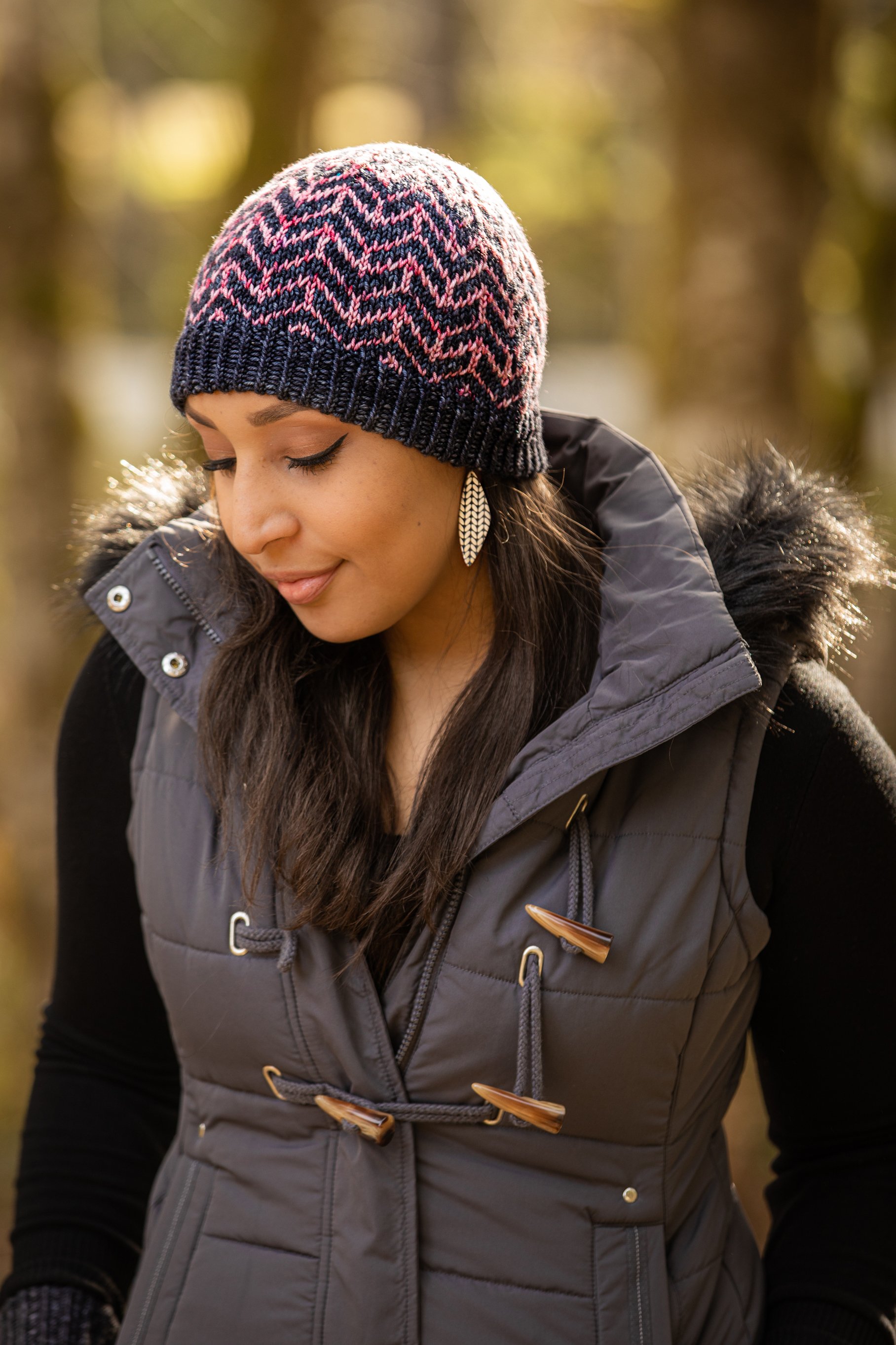
Two years after designing the Novemberist set, I returned to colorwork. I’d spent the time knitting texture, cables, and lace—different ways to play with yarn and stitch patterns—but colorwork was calling, and I just wanted to create. I also wanted an easy project for on-the-go knitting.
I pulled out the second chevron chart I’d swatched before I made the Novemberist Hat, one of the two I hadn’t used. Then I borrowed the brim construction from Aslyn, a pattern I’d developed in those two years, and started playing with how they could work together. I found the yarns in my stash once again: a vibrant, speckled pink from Stitches West 2020 and a deep charcoal grey I’d also picked out at the local yarn shop where I held my first trunk show. They were unexpected together—nothing like the jewel tones I usually reach for. But knitting with that pink? Different colored speckles emerged with each strand, and every stitch had its own character. I couldn’t wait to get to the next one.
My favorite part though? That was designing the crown. As I was testing the shaping I’d charted, the stitch pattern surprisingly formed itself into a geometric star. It’s not obvious from the chart, or even while you’re knitting it. The fabric just condenses, each round gets faster, and then suddenly it’s there. Like a reward for your effort. That’s Kestra.

Corbin is a striped hat that utilizes 3 complementary colors and looks great on both ladies and gents. This fun and stylish hat is the perfect canvas for playing with color and using up yarn scraps. Worked from the top down with a fully lined interior for a finished look, it provides double the warmth and is easily customized for larger or smaller heads. Matching fingerless mitts add a nice touch and complete the look for those that prefer to wear their knits in sets.

After finishing three textured sweaters and a shawl back-to-back, I was looking for something small—what some knitters might call a “palate cleanser.” A friend who’s an avid sock knitter and always keeps a pair of socks on the needles suggested I make some. I loved the idea, especially as it had been several years since I knit socks. There’s also nothing quite like the feeling of handmade socks.
It’s hard for me to do anything vanilla, though, and I wanted the finished socks to have a lovely, squishy texture on someone’s feet. So I chose stranded colorwork using the same geometric chevron motif from the Kestra Hat and Mitts. And I knew exactly which colors: Midknit Cravings—a friend and dyer whose work I adore—had test knitted the Kestra Hat for me the year before in Shiraz and Petal. I loved them together so much, I just had to use them too.
The construction also mattered. I’d never designed socks before. But just like a good top-down sweater, toe-up socks made sense for the ability to try on as you go. And I chose a forethought heel to ensure an uninterrupted colorwork pattern while giving you good heel placement. No cutting required; just straightforward, satisfying knitting.
A fun group of experienced sock knitters tested and confirmed that the technical choices worked. The Turkish cast on became a new favorite technique. The forethought heel won them over. The PDF layers feature solved a real problem: knitters could flip the chart to match their chosen colorways instead of doing mental color swaps. I also learned that sock fit is surprisingly similar to sweater fit—instep circumference, foot width, and length from toes to heel all matter the same way.
All the design work, testing, and lessons learned are built into this pattern. You just bring the skill you already have and go straight to the knitting. So if you’re ready for something that’s quick to knit, genuinely squishy to wear, and satisfying to finish, this is it.