Novemberist Mitts



Novemberist Mitts
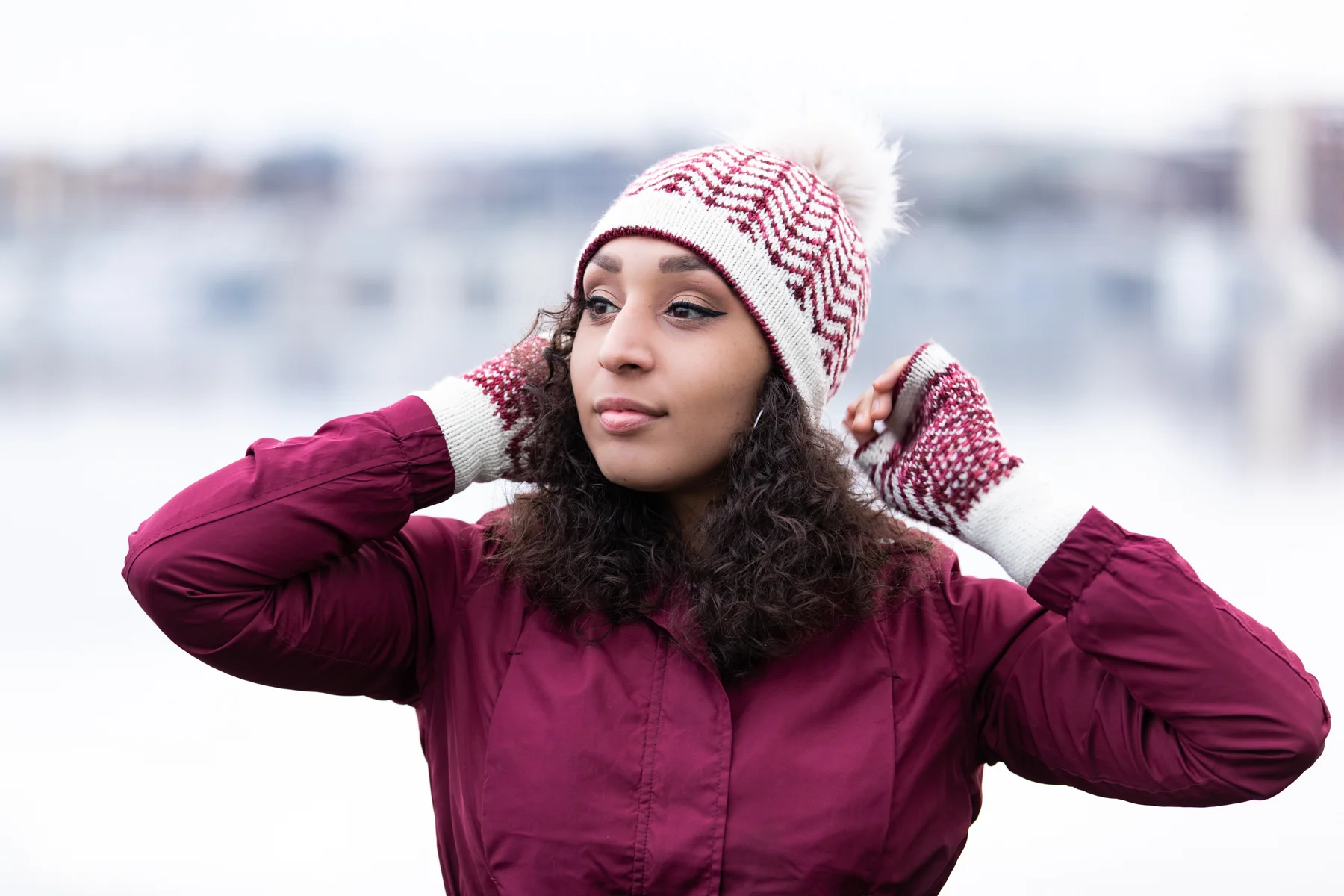
The hat was barely off the needles when I cast on the mitts. That November had been a whirlwind—my first trunk show, the trip to Victoria with my husband Cody and his cousin, all of it. And now I’d finally learned how to knit stranded colorwork and made the hat I’d been dreaming about. It had been awkward at first, to use both hands to hold separate yarns, but so satisfying. When Cody helped me choose the colors for the final sample—the warm red with rust and strawberry undertones, that pop of it peeking out from the turned brim—I knew immediately: this hat needed matching mitts.
But I didn’t want to just repeat the hat. I wanted to keep playing with the colorwork on a different canvas—a smaller, more intimate space. I also had an idea for a second stitch pattern on the palms, something complementary and unexpected. And I wanted to explore a unique approach to construction, a way to keep the colorwork flowing continuously around the hand instead of interrupting it with a standard thumb gusset.
They came together so quickly. Each one knit up in just a couple days of focused time, and when I slipped on the completed pair, they were satisfyingly warm and cozy. They tied the whole look together—the colors, the techniques, all of November compressed into something wearable on your hands.
If you’ve made the hat, you already know how this goes—except faster, and with one more stitch pattern to discover.
What makes them special
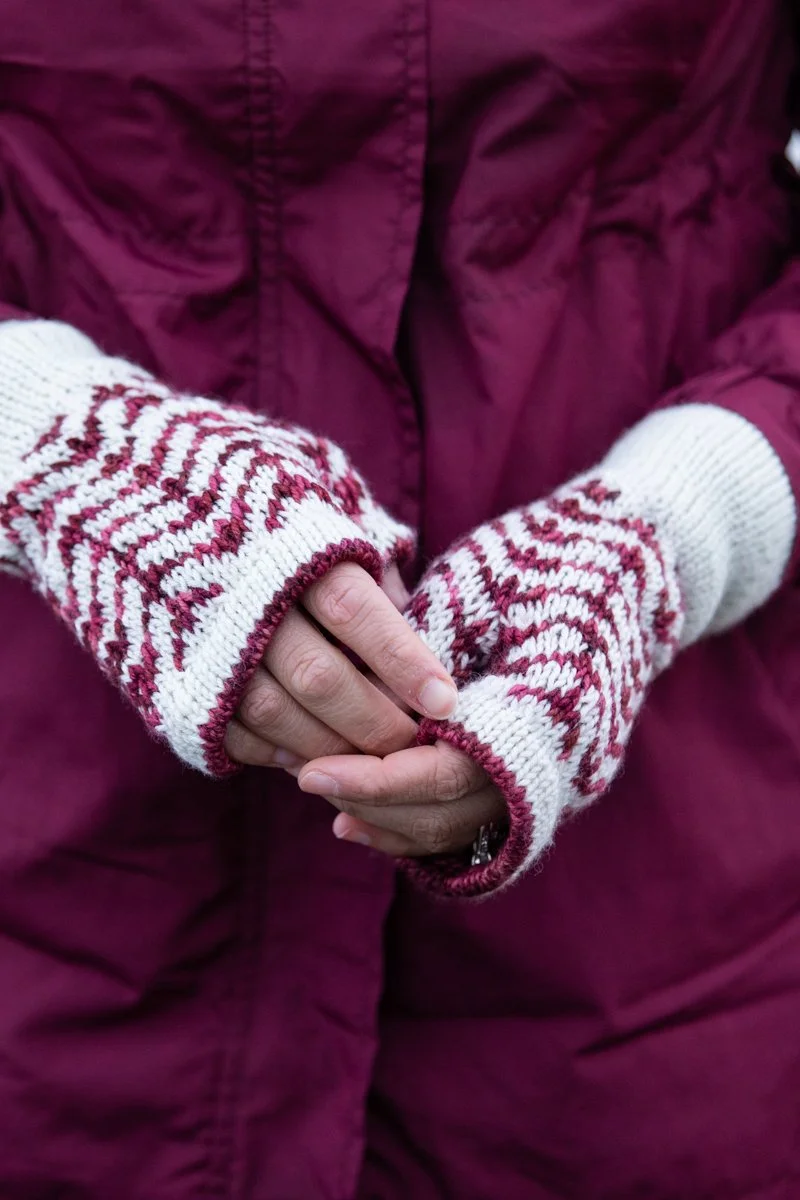
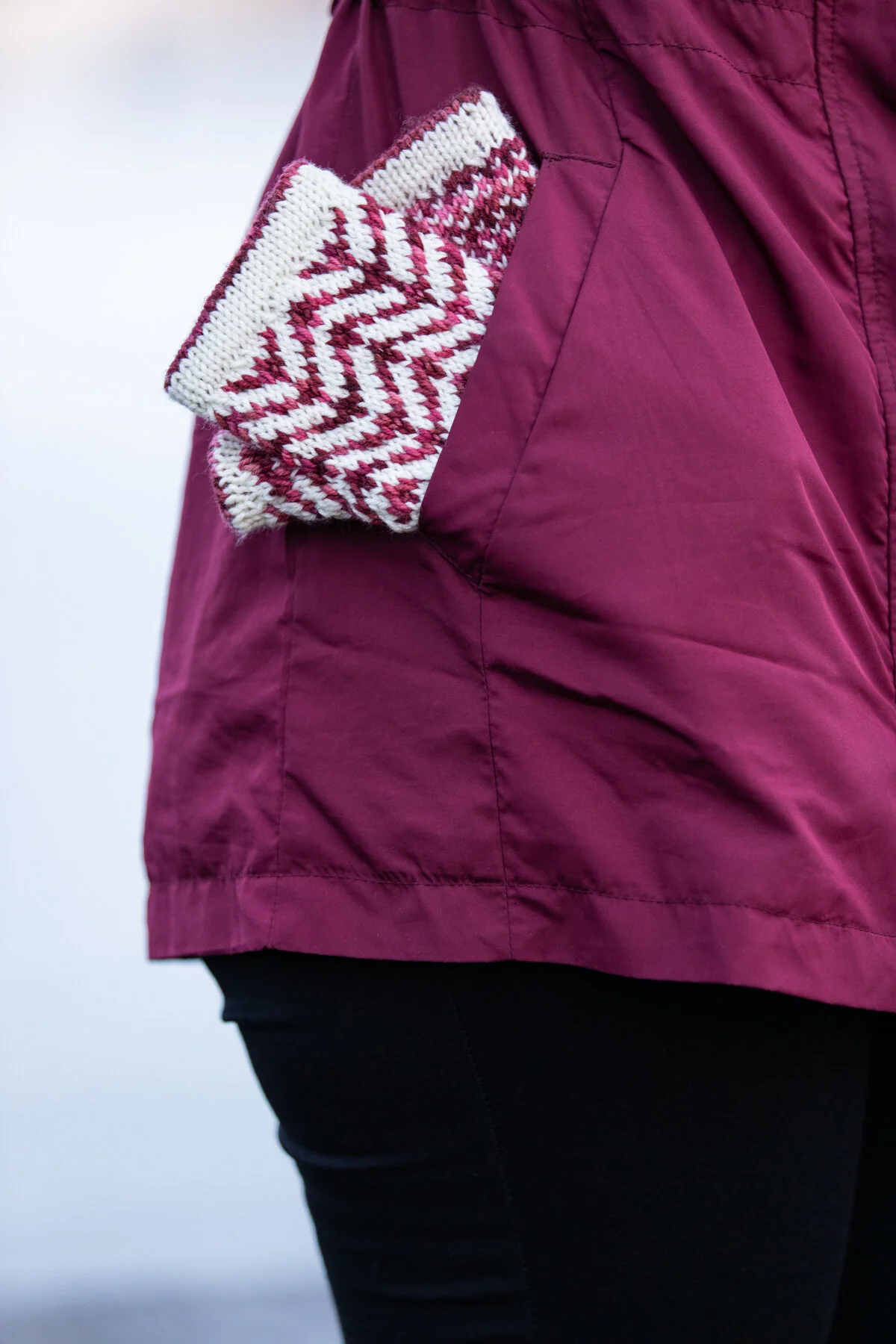
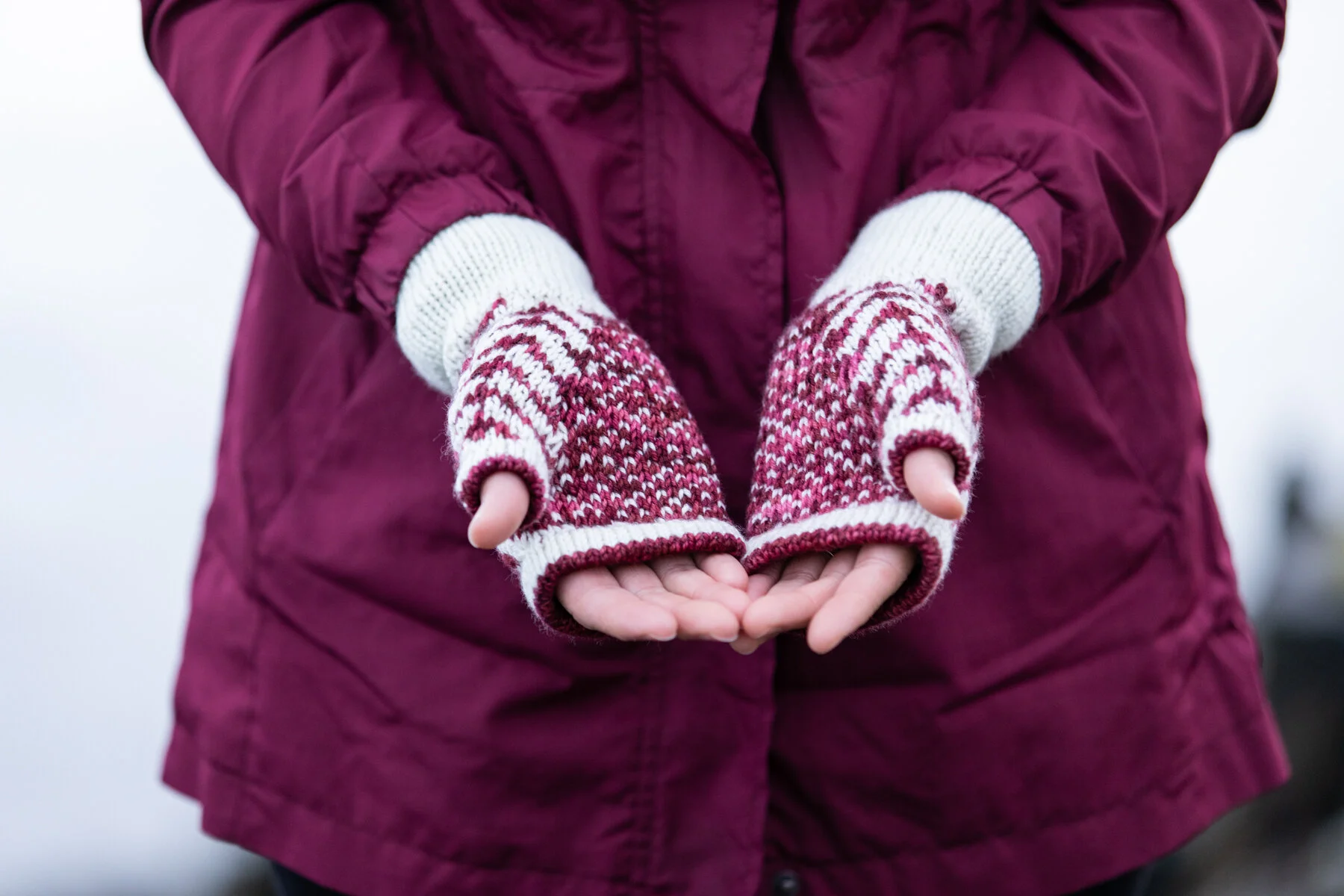
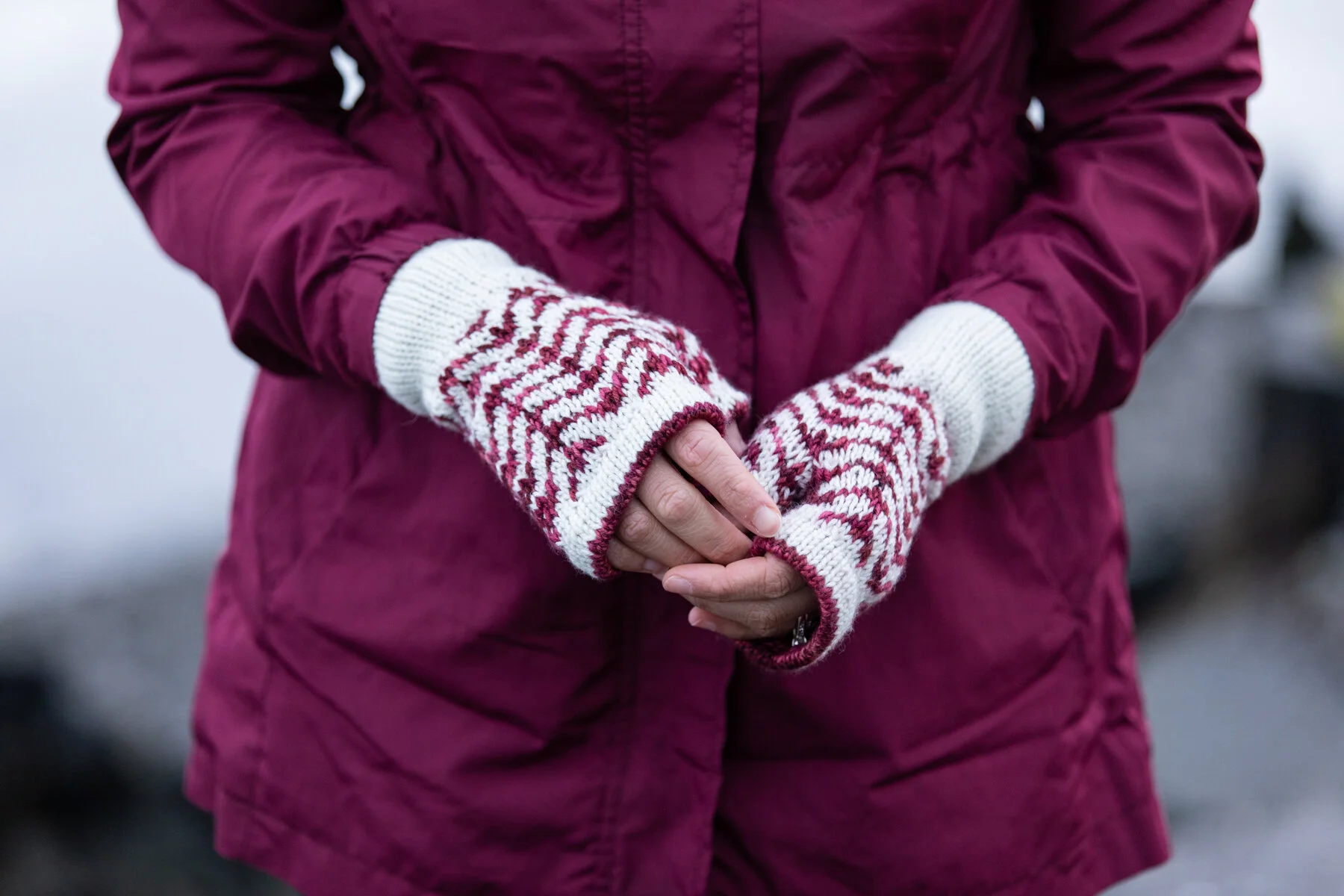
Doubled cuffs and openings. Two layers of fabric for genuine warmth in a fingerless design. The contrast color edges add a polished finish.
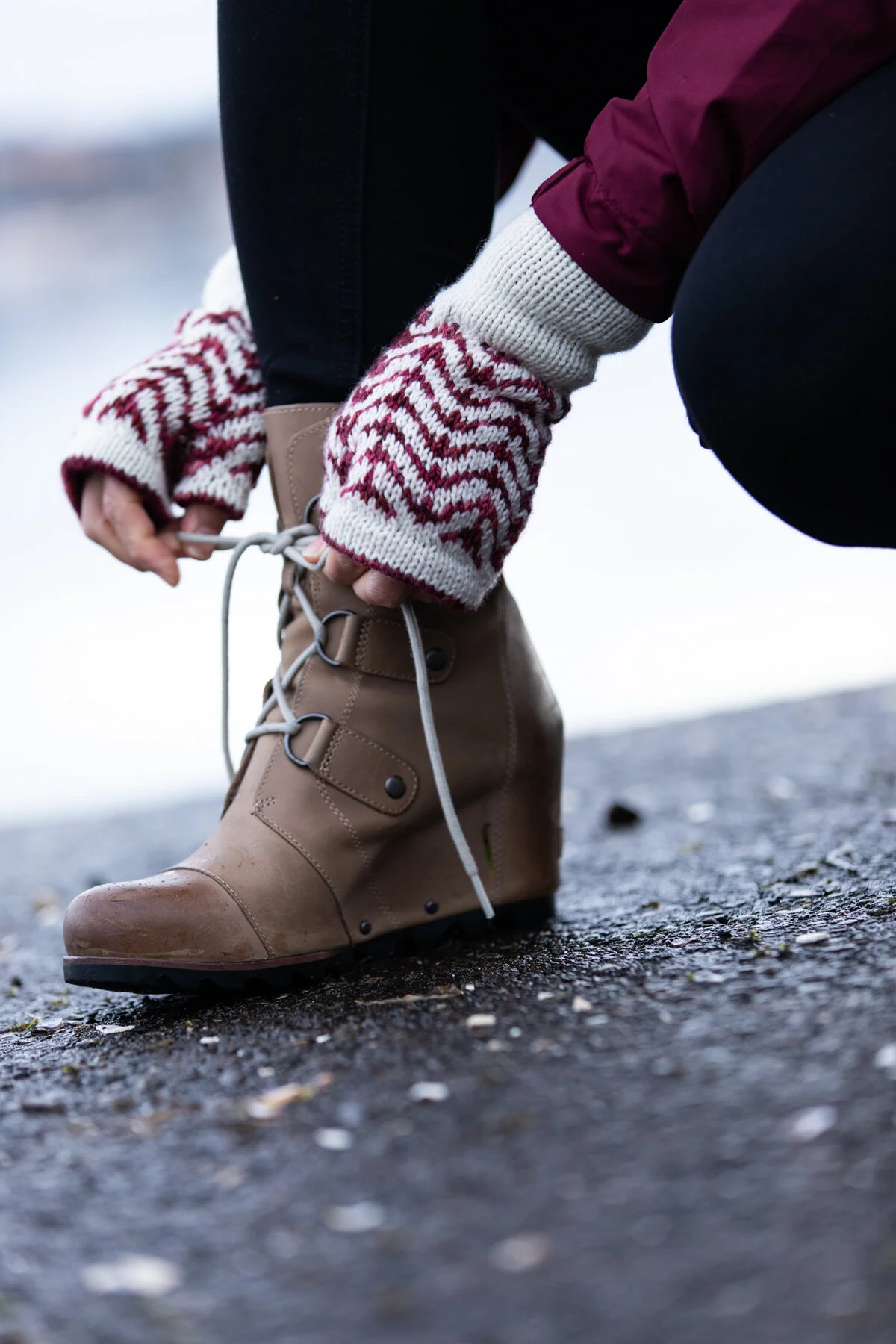
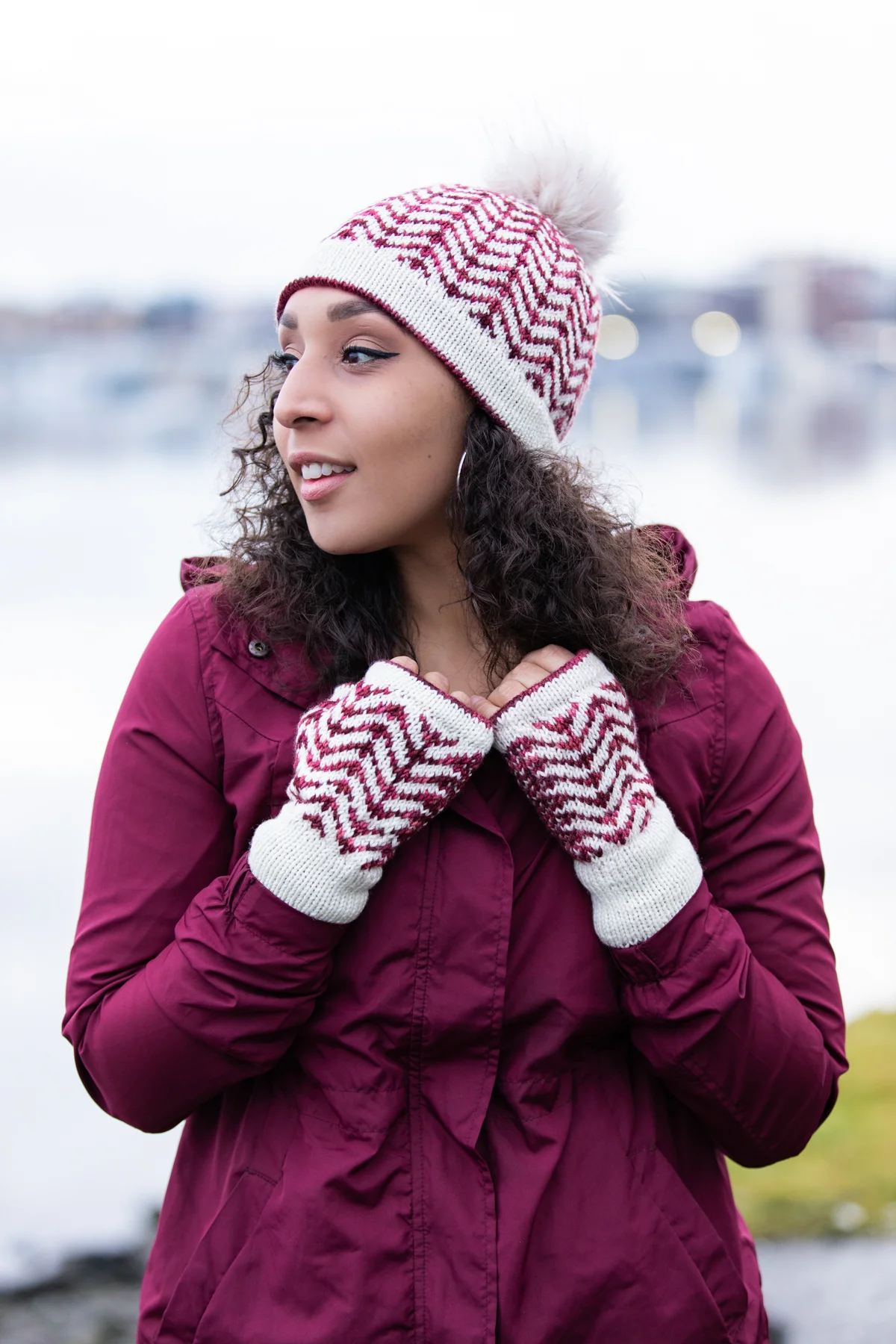
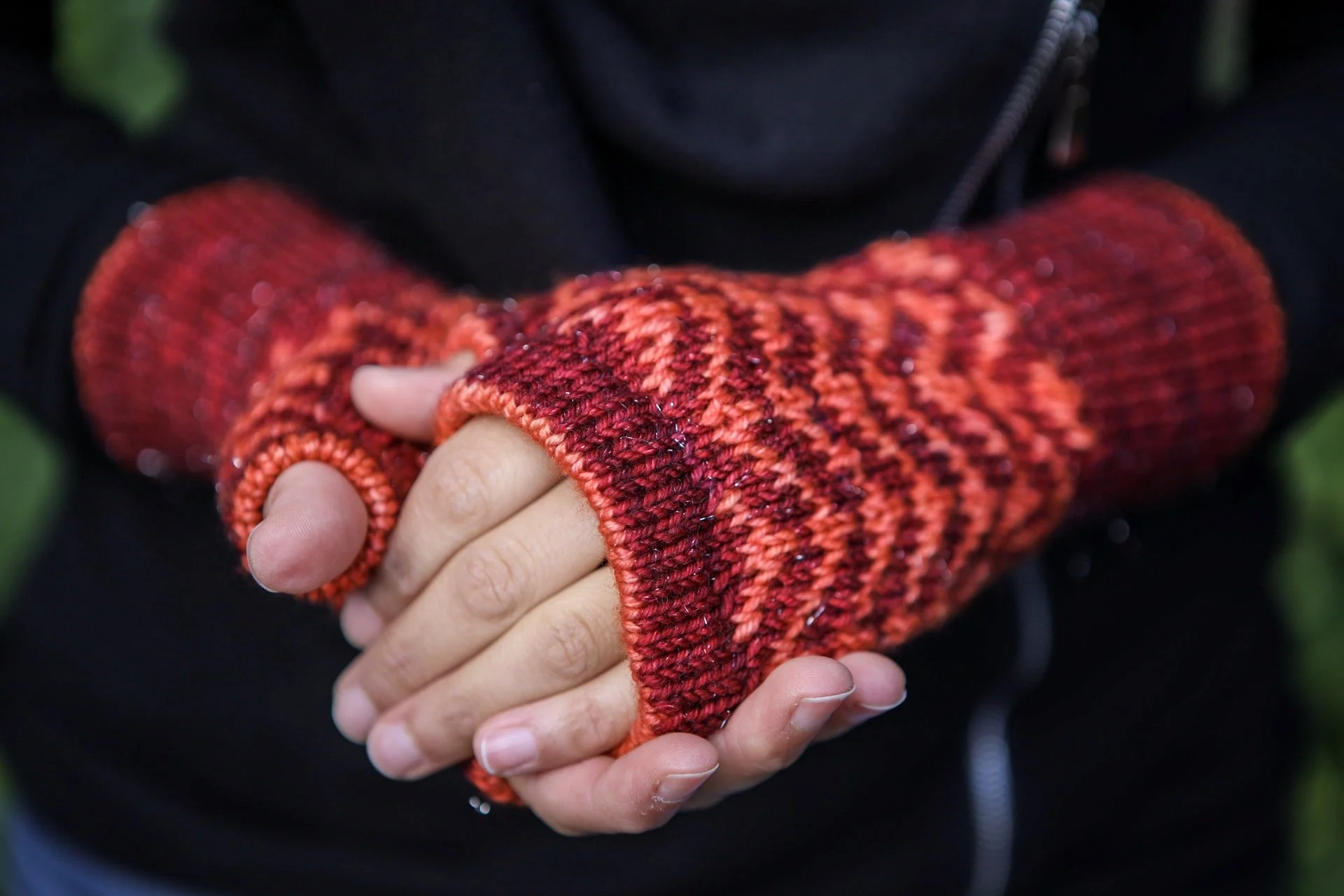
Seamless colorwork. A nontraditional thumb gusset means the chevron pattern stays continuous around the outside of the hand.
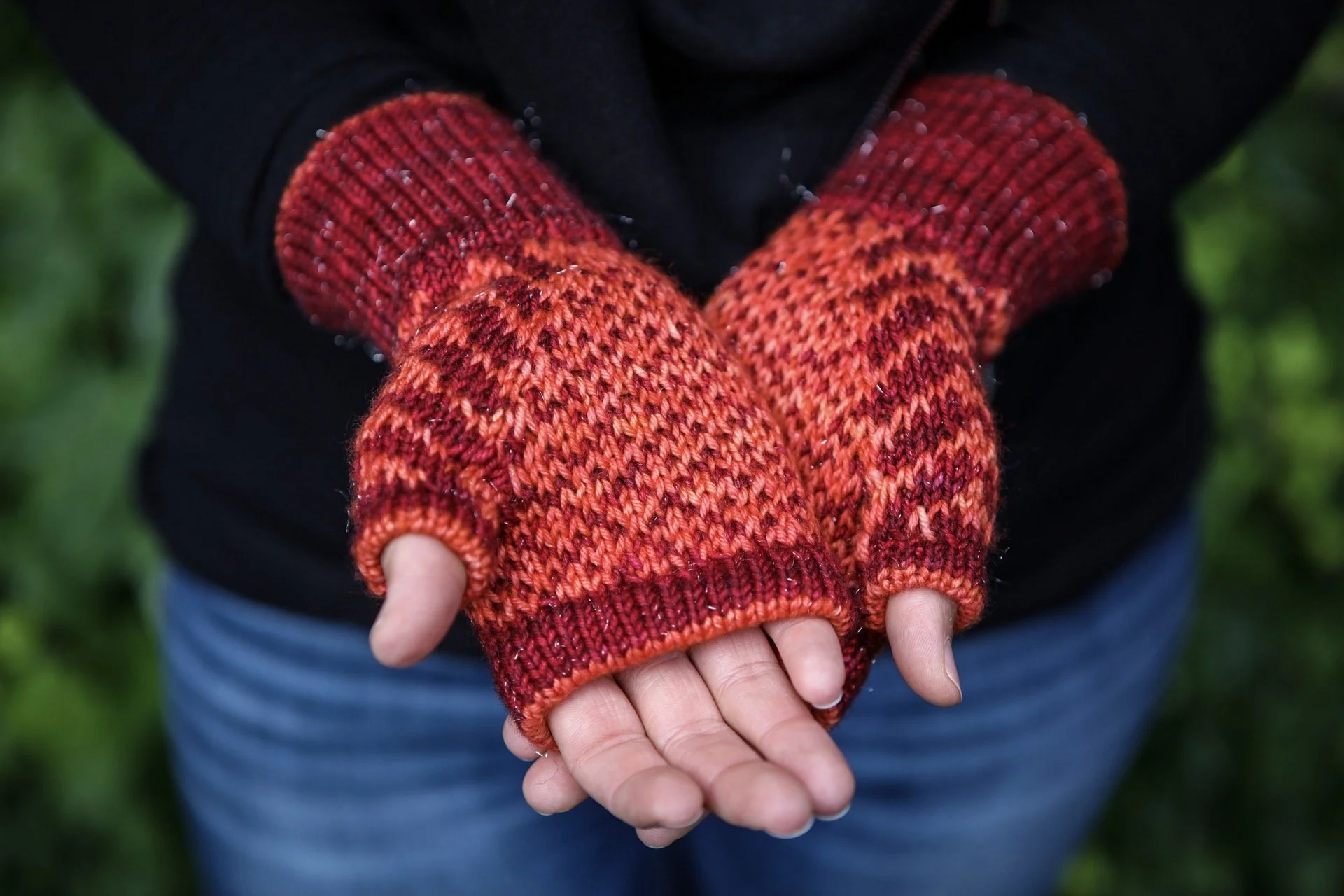
A second stitch pattern on the palm side. Mostly hidden—you’ll catch glimpses at the outer edges—but there to discover when you hold out your hands.
Quick to finish. A couple days of knitting for each mitt. Perfect for using up those leftover yarns from the hat.
What other knitters have said
“Super clever way of making the thumb gusset and great design. If you don’t like ribbing these mitts are for you.”
“So SQUISHY! I love how much weight these mittens have. They are definitely a cold weather fingerless mitt. I’ve never done a folded brim before so I was a little skeptical. But honestly I love how it turned out. The cuffs have the same thickness of the colorwork section which I really love.”
“My first colour-work project using some leftovers in stash . . . . I’ve found it a learning curve but the pattern is clear and well written so i’ve not had any issues.”
“I love these mitts! The pattern is well-written and easy to follow. I was a little confused when starting the hem stitches, but once I got going, it was simple. Just remember to read all the notes in the pattern.”
– Grace O’Neill of Babbles Travelling Yarns

What you get
A clear, downloadable PDF. With tips for stranding the colors, catching floats, and instructions for working the chained provisional cast on—all the techniques you need to make these mitts beautifully.
A video for the provisional cast on. Learn the technique before you cast on, or reference it while you work.
One size that works for most. Adjust your gauge or yarn weight if you need a custom fit.
Individualized instructions for each mitt. No reversing or mirroring instructions yourself—each mitt has its own written instructions so you can knit both confidently.
Ready to explore the colorwork further?
The hat was barely off the needles when I cast on the mitts. That November had been a whirlwind—my first trunk show, the trip to Victoria with my husband Cody and his cousin, all of it. And now I’d finally learned how to knit stranded colorwork and made the hat I’d been dreaming about. It had been awkward at first, to use both hands to hold separate yarns, but so satisfying. When Cody helped me choose the colors for the final sample—the warm red with rust and strawberry undertones, that pop of it peeking out from the turned brim—I knew immediately: this hat needed matching mitts.
But I didn’t want to just repeat the hat. I wanted to keep playing with the colorwork on a different canvas—a smaller, more intimate space. I also had an idea for a second stitch pattern on the palms, something complementary and unexpected. And I wanted to explore a unique approach to construction, a way to keep the colorwork flowing continuously around the hand instead of interrupting it with a standard thumb gusset.
They came together so quickly. Each one knit up in just a couple days of focused time, and when I slipped on the completed pair, they were satisfyingly warm and cozy. They tied the whole look together—the colors, the techniques, all of November compressed into something wearable on your hands.
If you’ve made the hat, you already know how this goes—except faster, and with one more stitch pattern to discover.
The Knitty-Gritty
Description
The Novemberist mitts are part of a hat and mitt set dreamed up during an especially memorable November. Made in two high-contrast colorways, these fingerless mitts are doubly thick throughout with turned hems at each opening and a chevron stitch pattern achieved by stranded knitting—both features that make these mitts warmer than your average fingerless mitts!
Sizes
One size [Women’s Medium]
Finished Measurements
3¾” (9.5 cm) wide, 8¼” (21 cm) tall [7½” (19 cm) circumference around knuckles] when laid flat
Yarn
Approximately 176 yards (161 meters) DK weight yarn:
86 yards (79 meters) main color
90 yards (82 meters) contrasting color
Needles & Hooks
US 6 (4 mm) double pointed needles OR appropriate needle(s) for your preferred method of knitting small circumferences in the round
Spare US 6 (4 mm) or no more than 2 sizes smaller circular needle, 16” (40 cm) or longer
Size G (4 mm) crochet hook (for provisional cast on)
Change needle size if necessary to obtain correct gauge.
Gauge
Stockinette Stitch: 20 sts and 32 rnds = 4” (10 cm), in the round, after blocking
Stranded Colorwork: 28 sts and 26 rnds = 4” (10 cm), in the round, after blocking
Notions
(1) Stitch marker for beginning of round (optional)
(1) Locking or split-ring stitch marker
Waste yarn (in a third, contrasting color; smooth; and no thicker than working yarn)
Tapestry needle
Grab your leftover yarn and cast on.
The hat was barely off the needles when I cast on the mitts. That November had been a whirlwind—my first trunk show, the trip to Victoria with my husband Cody and his cousin, all of it. And now I’d finally learned how to knit stranded colorwork and made the hat I’d been dreaming about. It had been awkward at first, to use both hands to hold separate yarns, but so satisfying. When Cody helped me choose the colors for the final sample—the warm red with rust and strawberry undertones, that pop of it peeking out from the turned brim—I knew immediately: this hat needed matching mitts.
But I didn’t want to just repeat the hat. I wanted to keep playing with the colorwork on a different canvas—a smaller, more intimate space. I also had an idea for a second stitch pattern on the palms, something complementary and unexpected. And I wanted to explore a unique approach to construction, a way to keep the colorwork flowing continuously around the hand instead of interrupting it with a standard thumb gusset.
They came together so quickly. Each one knit up in just a couple days of focused time, and when I slipped on the completed pair, they were satisfyingly warm and cozy. They tied the whole look together—the colors, the techniques, all of November compressed into something wearable on your hands.
If you’ve made the hat, you already know how this goes—except faster, and with one more stitch pattern to discover.
Buy it on Ravelry.
You may also like . . .
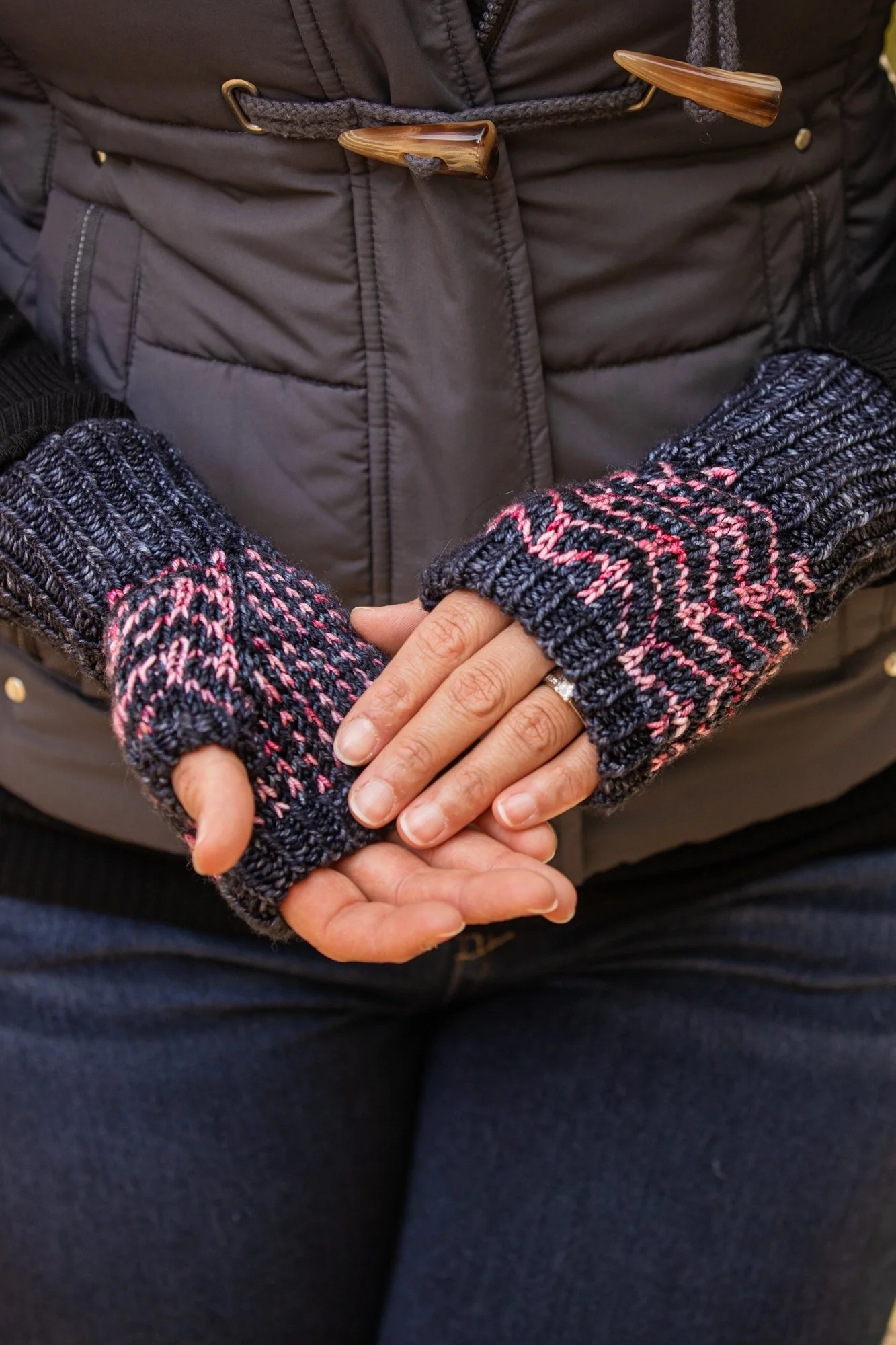
The mitts were always part of the plan. From the moment I finished the Kestra Hat, I knew I’d make matching mitts. I still had plenty of yarn leftover, the main chevron stitch pattern was meditative and fun, and my hands were always cold. But I wasn’t able to cast on for a couple months. In that time, my husband Cody and I had moved into our new house and added Brogan, a new puppy, to the family. Things were busy, but in the best way.
At the earliest hint of a break, I went back to my charts and picked up my needles. For the shaping, I used what I’d learned from the Novemberist Mitts but, like that pattern, I wanted to explore something different, not just a repeat of the hat. So I added a second, unique stitch pattern for the palms. This detail, a visual break from the top of the hand and thumb gusset, became one of my favorites.
Over the next few weeks, I snuck in stitches during evenings and weekends, between work and life. Without fail, Brogan or our other dog, Wes, would settle right beside me on the couch, and there was something special about working on these mitts in our new house—making something not only with but also for my hands while everything else was finally slowing down.
If you’re looking for a reason to pause—something rhythmic that settles into your evenings—here they are.

Corbin is a striped hat that utilizes 3 complementary colors and looks great on both ladies and gents. This fun and stylish hat is the perfect canvas for playing with color and using up yarn scraps. Worked from the top down with a fully lined interior for a finished look, it provides double the warmth and is easily customized for larger or smaller heads. Matching fingerless mitts add a nice touch and complete the look for those that prefer to wear their knits in sets.

After finishing three textured sweaters and a shawl back-to-back, I was looking for something small—what some knitters might call a “palate cleanser.” A friend who’s an avid sock knitter and always keeps a pair of socks on the needles suggested I make some. I loved the idea, especially as it had been several years since I knit socks. There’s also nothing quite like the feeling of handmade socks.
It’s hard for me to do anything vanilla, though, and I wanted the finished socks to have a lovely, squishy texture on someone’s feet. So I chose stranded colorwork using the same geometric chevron motif from the Kestra Hat and Mitts. And I knew exactly which colors: Midknit Cravings—a friend and dyer whose work I adore—had test knitted the Kestra Hat for me the year before in Shiraz and Petal. I loved them together so much, I just had to use them too.
The construction also mattered. I’d never designed socks before. But just like a good top-down sweater, toe-up socks made sense for the ability to try on as you go. And I chose a forethought heel to ensure an uninterrupted colorwork pattern while giving you good heel placement. No cutting required; just straightforward, satisfying knitting.
A fun group of experienced sock knitters tested and confirmed that the technical choices worked. The Turkish cast on became a new favorite technique. The forethought heel won them over. The PDF layers feature solved a real problem: knitters could flip the chart to match their chosen colorways instead of doing mental color swaps. I also learned that sock fit is surprisingly similar to sweater fit—instep circumference, foot width, and length from toes to heel all matter the same way.
All the design work, testing, and lessons learned are built into this pattern. You just bring the skill you already have and go straight to the knitting. So if you’re ready for something that’s quick to knit, genuinely squishy to wear, and satisfying to finish, this is it.